My photo
Ontario, Canada
I am a wife, mother and grandma who enjoys the many aspects of homemaking. A variety of interests and hobbies combined with travel keep me active. They reflect the importance of family, friends, home and good food.
Cook ingredients that you are used to cooking by other techniques, such as fish, chicken, or hamburgers. In other words be comfortable with the ingredients you are using.
--Bobby Flay

For Your Information

Please watch this area for important information like updates, food recalls, polls, contests, coupons, and freebies.
  • [March 19, 2020] - Effective Mar 17, this blog will no longer accept advertising. The reason is very simple. If I like a product, I will promote it without compensation. If I don't like a product, I will have no problem saying so.
  • [March 17, 2020] - A return to blogging! Stay tuned for new tips, resources and all things food related.
  • [February 1, 2016] - An interesting report on why you should always choose organic tea verses non-organic: Toxic Tea (pdf format)
  • Sticky Post - Warning: 4ever Recap reusable canning lids. The reports are growing daily of these lids losing their seal during storage. Some have lost their entire season's worth of canning to these seal failures! [Update: 4ever Recap appears to be out of business.]

Popular Posts

Showing posts with label beverages. Show all posts

Friday, March 06, 2015

Using the Cup Drawer on the Bunn My Cafe Single Cup Multi-Use Brewer

Last week I excitedly wrote about our new Bunn My Café MCU that replaced our failing Keurig B60.  The new Keurig 2.0 will not allow you to brew any other coffee except that packaged in their Keurig licensed K-cups despite their original hoopla that you could have the convenience of a single brew while enjoying your own coffee by using their My K-cup filter.  Unfortunately, that decision has turned a lot of faithful users against Keurig.  It doesn't help that the old machines are simply refusing to brew.  It also doesn't help that Keurig is getting a lot of negative publicity from the manufacturers of K-cup like pods and environmental groups.  At any rate, the Bunn My Café MCU has a drawer designed to use K-cups and off brand cups meant for Keurig machines. 

I have very few Keurig licensed K-cups.  The reason being both cost and recycle-ability.  I do however, have a several non-licensed K-cups especially the soft bottom cups that are 97% recycle-able. It's nice that I will be able to use these cups in the Bunn.

The cup drawer for the Bunn is easy to use.  Open the lid but do not try to remove the lid from the hinge.  Place your desired K-cup or similar into the cup holder (1).  Close the lid down onto the K-cup (2) then give it a firm push to puncture the lid on the K-cup (3).  When seated properly, the lid of the cup drawer will rest neatly against the bottom of the cup drawer.  Place the cup drawer onto the Bunn, snapping firmly in place (4).  Add water to the Bunn then press brew (5).  When finished brewing (6) remove the cup drawer and empty.  Rinse so that it is ready for the next time you want to brew.

I took this short video to show how the Bunn brews slightly different than the Keurig.  There is an option of the Bunn to use a pulse when brewing.  This is used when brewing loose tea or if you want a stronger flavoured coffee.  When the pulse is turned on, the bottom light is indicated by red.  I didn't use pulse for this cup of coffee.  Once the cup drawer was in place with the desired K-cup, I hit brew.  The most notable feature about the brewing is the final burst of hot water.  This results in a more flavourful cup of tea or coffee.  It does cause a small amount of splattering.  The important thing to remember is to not add too much water to the reservoir.  Make sure you leave enough space to account for this final blast of water!  This final blast of hot water occurs with all of the drawers although it is not as pronounced with the plain water drawer.


I remove the brewing drawer and rinse out after each use.  This way, the Bunn is ready for the next use.  Unlike the Keurig, there is no issue with your tea having a little coffee off-taste.  The reason being, the only time the puncture needles come into contact with coffee is when using the cup drawer.  Everything else is brewed using a different drawer.  I was concerned that there would be a bit of coffee off-taste in my herbal teas using the ground coffee drawer but so far that has not been a problem.  If you switch to the Bunn and have the My K-cup or other reusable filter meant for the Keurig machines, there is no need to use them.  Simply use the ground coffee drawer.  It is a lot easier to clean than the reusable Keurig filters!


Wednesday, February 25, 2015

Goodbye Keurig, Hello Bunn

Like many people we embraced the concept of a single cup coffee brewer.  A single cup brewer can save a significant amount of money.  We bought our first single cup coffee brewer, a Melitta One:One that took special coffee pods.  At that time, the only place we could buy the pods was Zellers and Sobey's but then Zeller's discontinued them.  We found Sanka pods at Meijer's in the US so were still able to use the Melitta when Sobey's closed.  Finally, we bought a Keurig Special Edition (B60) to replace the Melitta.  The selling feature of the Keurig was we could use our own coffee rather than relying on the environmentally unfriendly K-cups.  In fact, I was so impressed with Keurig that we bought a mini for the office, and another larger unit for our vacation home.  All was well until, the only four year old Keurig B60 started acting up!

During our brief three weeks home in the fall between our two longer stays at our vacation home, the Keurig would say it was brewing but nothing happened.  I cleaned it and all seemed fine.  We arrived home in the early morning of December 22 after being on the road for eighteen and a half hours.  With only four hours sleep, I needed coffee!  The Keurig failed but after a lot of opening, shutting, and restarting I finally got it working.  From there it worked sporadically.  I went online and found a site with instructions how to fix.  I cleaned the Keurig with vinegar then cleaned it again, then cleaned the heads with the special K-cup cleaner then cleaned again only to be rewarded with half cups of coffee if and when it would brew.  I repeated including adding in the spanking.  The problems persisted.

In the meantime my temper was rising.  I checked the new Keurig 2.0 ready to buy on the spot only to see it will only take Keurig licensed K-cups and not allow you to brew your own coffee.  This renders the Keurig 2.0 completely useless if you should move to an area where Keurig licensed K-cups are unavailable or Keurig goes out of business.  The one that does allow you to use your own coffee has almost zero features and looks cheap.  We were visiting our kids in January where we used their Bunn My Café MCU marveling at how good the coffee was.  We came home where I cussed at the Keurig a few more times before ordering a Bunn My Café MCU. 

I ordered the Bunn My Café MCU through BuyCoffeeCanada.com on Wednesday and it arrived the following Friday so I was quite impressed.  The total price with shipping and taxes was $231.65.  Consider though that when I looked at the Keurig 2.0 it was $189.99 plus taxes $24.69 for a total of $214.68 and it wouldn't brew the coffee of my choice.

The Bunn My Café MCU is a four in one brewer that uses ground coffee or loose leaf tea,  K-cups (or similar), soft pods or tea bags and hot water.  There are four drawers designed for each specific usage (bottom left).  There is an internal water storage tank but water you need to add water each time you use it.  This is not a huge change for me since I always poured water into the external water reservoir of the Keurig with each use.

The Bunn has a slightly smaller footprint than the Keurig (bottom right).  There is no on or off button, simply brew with optional pulse for stronger coffee and tea.  There is no clock on auto-off.  The Bunn brews at 200°F which is 8°F higher than the Keurig.  The higher temperature does give a better tasting coffee, full flavoured without bitterness.  After 6 hours idle, the Bunn temperature drops to 140°F and enters sleep mode after 26 hours.

Bunn My Cafe Single Cup Brewer MCU set up ready to use
The worst part of setting up the Bunn My Café MCU was waiting for it to warm a bit after being in a cold shipping van.  I felt it best not to plug it in immediately especially since it has been bitterly cold.  So I drooled over the Bunn in anticipation while drinking the last cup of coffee I would make with the Keurig.  Once the Bunn had warmed a bit, I plugged it in and primed it.  I washed all of the drawers.  My reward was a hot, deliciously brewed cup of coffee!

A final word on Keurig:  I was a happy Keurig user until my brewer that was only four years old stopped brewing properly.  The funny thing is, one of my friend's had her Keurig quit the same week except she could not even coax a final cup of coffee from it.  Keurig's selling feature was being able to use your own coffee meaning you did not have to contribute to the landfill.  They took that feature away with the Keurig 2.0 at a time when there is growing pressure as to the damage the K-cups are doing to the environment because they are not recyclable plus their failing brewers will end up in the landfill as well.  To me, that is not good business.  Keurig has lost my business!

Normally I have one kitchen catcher garbage bag per week if that.  That is for the entire house not just the kitchen.  Even though we  use the My K-cup filter on a regular basis we do use the K-cups for company and entertaining.  Last week, almost a quarter of the kitchen catcher was used K-cups!  It quickly became apparent that we have become part of the problem by using the K-cups.  I'll use up what K-cups I have but won't be restocking Keurig licensed K-cups.  I may possible still stock a couple of the soft bottom pods that were working in the old Keurig but not the Keurig 2.0.  These cups have only a small plastic ring that can be re-purposed.


Wednesday, February 04, 2015

Yellow Kitchen Syndrome

I am a firm believer in using food to heal the body.  I'm am fighting arthritis much the same way I do with other health problems, using foods that heal, avoiding foods that harm and exercise.  Two foods that are currently being used to treat arthritis are NEM (natural egg membrane) and curcumin (turmeric extract).  NEM takes about 7 days to notice a reduction in pain.  I specifically use Curcumin C3 Complex (1,160 mg/serving) in addition to turmeric. 

ground tumericTurmeric is the ribosome of a perennial plant in the ginger family native to South Asia growing in temperatures of 20 to 30°C.  It is considered the Indian saffron, a cheaper alternative to regular saffron.  Turmeric it's commonly dried and powdered then used as a spice and curries as well as a dye for foods like mustard.   Turmeric will stain just about anything it comes into contact with, hence the yellow kitchen syndrome.

Turmeric is not only used for its culinary properties but also it's medicinal properties.  It can be made into a paste then used on the skin to reduce hyperpigmentation.   There has been a lot of interest in turmeric specifically the active ingredient, curcumin.   Turmeric is antioxidant.   Antioxidants help protect cells in the body by fighting free radicals to help fight against aging and prevent cancer.  Turmeric also reduces inflammation so eases joint pain.


The recommended dosage of turmeric is one 300 mg capsule at each meal, two or three times a day for a maximum dosage of 1 to 3 g per day . If taking a standardized form of curcumin,  the recommended dosage is 1200 to 1800 mg of per day.  Turmeric does have some negative side effects it may cause nausea if taken on an empty stomach.   It lowers blood sugar so may be a problem for those who are diabetic.  Turmeric lowers blood pressure and thins the blood.

As with many herbs and spices that are used for medicinal purposes the issue becomes a bio-availability.   That means even though you take the recommended dosage your body cannot necessarily use it in that form without a bit of help.   Bio-availability of turmeric is increased by adding piperine, the active ingredient in black pepper.   Bio-availability can be further increased by heating either the turmeric or curcumin. 
BCAA Turmeric Ginger Smoothie
The most common way to use turmeric is in curries but it is not practical for me to eat curry every day.  Since I already take curcumin, I turned to turmeric to boost the amount of curcumin I get eat day.  Turmeric is considerably less expensive and readily available.  The curcumin I take is mail order so there is always that concern of keeping enough on hand and having a substitute just in case.

I generally have a whey protein smoothie mid-morning.  This was the perfect target for turmeric.  I used  a BCAA (branch chain amino acids) 100% whey protein powder, cottage cheese, unsweetened almond milk, 1 tsp turmeric. 1 tsp fresh ginger and a dash of black pepper to make a yummy smoothie.  Turmeric is pungent so the flavour dominated the smoothie but not in an unpleasant way.  One teaspoon of turmeric is 3 g, a good booster for the curcumin.  I liked this combination enough that I've made it a few times now.  It comes in at 235 calories and 33 g protein per 12 oz serving.

Golden Milk
As luck would have it, I was on Facebook when several posts came through my timeline talking about the wonders of Turmermic Tea aka Ancient Golden Milk.  There were many variations some containing coconut milk, others containing other spices like cinnamon and cayenne pepper, and all sweetened with sugar, honey or maple syrup.  I decided to keep my version simple.

Golden Milk 
recipe by Garden Gnome

1 c unsweetened almond milk
2 tsp turmeric
1/4 tsp black pepper
1/4 tsp stevia

Warm almond milk slightly.   Mix the dry ingredients in a small bowl then pour just enough warmed milk in to make a thin slurry.  Pour the slurry into the remaining milk and mix well.  Continue heating until mixture comes to a low boil.  Remove from heat.  Pour into mug and enjoy.

I was concerned that the turmeric would be overpowering in this hot beverage but surprisingly it isn't.  I actually prefer the Golden Milk to the smoothie.  It has a warm, pleasant flavour.  I have been enjoying one of these hot drinks in the afternoon.  My arthritis pain has lessened.  The visible signs (redness, swelling) especially in my hands is significantly reduced.  This one is a keeper and it's only 53 calories!


Wednesday, February 19, 2014

Strawberry Dream Smoothie

You might be wondering why I have been posting so many smoothie recipes lately.  Smoothies have quickly become a breakfast staple for busy families trying to get everyone out the door and on their way for the day.  They are also very popular for the fitness crowd.  You can pack a lot of nutrition into a smoothie with very little effort and minimal muss.  It's a way of getting the nutrition of vegetables like spinach without the taste of spinach.  Surprisingly, spinach is one of those vegetables that you can't even taste in a smoothie!  Most smoothies will keep nicely in the refrigerator for the day as well so any left overs can be used as an easy, nutritious after school snack.  At any rate, I am experimenting with smoothies for those reasons but I also have another goal in mind that I will share with you shortly.

strawberry dream smoothie
I made a strawberry dream smoothie for us to share on Valentine's Day.  The pretty pink colour was quite appropriate to welcome the start of this special day.  A little dash of cocoa on top would have been a nice addition but I didn't think about it at the time.  If you aren't weighing your ingredients, use the amounts in brackets for this delicious smoothie.

Strawberry Dream Smoothie
recipe by:  Garden Gnome

40 g Body Fortress 100% Whey Protein Powder, Vanilla Creme (1 scoop)
170 g strawberries (5 extra large)
136 g banana (1 large)
500 ml (2 c) Silk almond milk original

Place the ingredients in a blender.  Blend until smooth.  Serve.

Yield: 1.125 L (4.5 c)
Serving size: 355 ml (12 oz)
Nutritional value per serving: 111 calories, 17 g carbohydrates, 2 g fat, 7 g protein, 101 mg sodium, 2 g fibre


Tuesday, February 11, 2014

Chocolate Monkey Smoothie

Smoothies are easily modified for fitness training and weight loss, however they can also be simply enjoyed as a healthy beverage.  The real challenge when it comes to smoothies is to not make them too high calorie.  The work around for the calorie challenge is to reduce the serving size.  Most of the smoothies I make give a yield of about 685 ml with a total caloric value of 450 calories or more.  I usually plan on four 170.4 (6 oz)  servings with a caloric value of about 120 calories depending on the ingredients.  Since most smoothies will keep for a day or two in the refrigerator, one smoothie is enough for two breakfast servings for us when combined with other foods like fruit, cheese, or oatmeal.
  

chocolate monkey smoothie
The chocolate monkey has been a popular milk shake flavour that is easily duplicated in a smoothie.  I like to use almond milk that is lower in calories that 2% milk and is lactose free.  Almond milk is lower in protein than 2% milk which is why I like to add ingredients higher in protein.  Protein powder greatly boosts the protein content but unless you are training it isn't really necessary.  Peanut butter is a good alternative protein booster.  The chocolate monkey smoothie combines the flavours of chocolate, peanut butter and banana into a deliciously delightful, silky smoothie that is sure to please!

Chocolate Monkey Smoothie
recipe by:  Garden Gnome

500 ml (2 c) Silk original almond milk
5 g (1 tbsp) Fry's premium cocoa powder
31 g (2 tbsp) Kraft smooth peanut butter
144 g (1 large) banana

Place the measured ingredients in blender.  Blend until smooth.  Serve

Makes 4 - 170.4 ml (6 oz) servings

Nutritional value per serving:  112 calories, 15 g carbohydrates, 3 g protein, 114 mg sodium, 2 g fibre

*The calculated nutritional value is based on the specified ingredient brands used.  Other brands can be substituted but may change the nutritional value.


Sunday, February 09, 2014

Avocado Dream Smoothie

I have never been a breakfast eater simply because my stomach does not tolerate anything well until I've been awake for a hour or so.  My normal breakfast time is about 11 AM regardless of how early I get up.  One recommendation for improving weight loss is to not eat anything for 12 hours before exercising which forces your body to burn fat rather than sugar.  That method suits me just fine.  I can eat up to about 9 PM then start my exercise the following morning at 9 AM.  I'm usually up before 7 AM and have a cup of black coffee about a half hour before exercising, something I did not think my stomach would tolerate but so far it is.  My current exercise routine is 90 to 120 minutes depending on what sessions I'm working on.  That means by the time I eat, I really need the protein!

avocado dream smoothie
I have been experimenting with smoothies to be used primarily as a source of protein for after my work-outs.  Yesterday, I shared my Berrilicious Protein Smoothie recipe.  That recipe used Life Clearly Fibre to add fibre to the smoothie but there are other ways to add fibre.  Avocados are high in protein, fibre and healthy fat.  Their rich, creamy almost buttery flavour make avocados perfect for smoothies.

The avocado dream smoothie  has a delightful delicious smooth, creamy flavour.  You would not know the spinach is an ingredient other than the green flecks.  A 6 oz serving has 8 g of protein and 3 g of fibre yet only 121 cal making this an ideal post exercise beverage.  I used weight measurements for accurate caloric tracking and replication.  If you are not tracking calories, you can use the amounts in brackets to make this delicious smoothie.

Avocado Dream Smoothie
recipe by:  Garden Gnome

500 ml almond milk
34 g baby spinach (small handful)
83 g strawberries (3 extra large)
112 g avocado (1 medium)
39 g Body Fortress 100% Whey Protein Powder, Vanilla Creme

Place ingredients in blender.  Blend until smooth.  Serve

Makes 4 - 170.4 ml (6 oz) servings

Nutritional value per serving:  121 calories, 10 g carbohydrates, 6 g fat, 8 g protein, 109 mg sodium, 3 g fibre


Saturday, February 08, 2014

Berrilicious Protein Smoothie

The weight management aisle of many grocery and drug stores carry a varied selection of protein, meal replacement and weight loss drinks.  I am not a fan of these drinks for a number of reasons.  Unless there is a medical reason for needing to use these types of drinks, I feel they are best substituted with a homemade version.  Homemade fruit smoothies and shakes have been fairly common for quite some time.  Smoothies are made in a blender so unlike the mixed fruit and vegetable juices from a juicer, retain their fibre content.  Fibre is beneficial for weight loss.  These drinks are an excellent way to get your recommended daily requirements of fruits and vegetables in one convenient drink.  Some folks enjoy a smoothie daily for breakfast while others enjoy them more often.

berrilicious protein smoothie
I have noticed two things since joining My Fitness Pal.  First, protein is recommended after a work-out to help maintain lean body mass during weight loss and build muscle during bulking.  Protein keeps you feeling full longer which also aids in weight loss.  Second, there is a strong reliance on smoothies for weight loss.  I also noticed that many fruit smoothies have high caloric values something not necessarily conducive to losing weight. 

We do not have smoothies on a regular basis.  I have been experimenting with smoothies to help increase my protein intake after my morning work-outs.  I am not relying solely on the smoothies though because they are only 6 oz keeping the calories low yet the protein high.  This works well for me in combination with nuts and cheese.  I use metric units to make calculating the caloric value of the smoothie for tracking purposes and to make replication easy. 

Berrilicious Protein Smoothie
recipe by:  Garden Gnome

250 ml almond milk
35 g mixed berries (I used 21 g raspberries and 14 g blueberries)
20 g Body Fortress 100% Whey protein powder, Vanilla Creme
3 g Life Clearly Fibre*
50 g banana

Place ingredients in blender.  Blend until smooth.  Serve

Yield: 2 servings, 170.4 ml (6 oz)

Nutritional value per serving: 105 cal, 16 g carbohydrates, 2 g fat,8 g protein, 101 mg sodium, 3 g fibre

*Life Clearly Fibre is a fibre dietary supplement with folate and B vitamins, 10 cal, 32 g fibre (inulin)  per rounded teaspoon (3.2 g) serving.  It can be added to beverages or soft foods to increase the fibre content. 


Tuesday, December 17, 2013

Eggnog, A Holiday Tradition

The holidays are filled with a plethora of culinary delights.  Unfortunately, all of these tempting delights can be problematic for those on restricted diets, those with food allergies or intolerances or those simply trying to maintain their weight.  The average person gains one pound over the holiday season although some sources report the average gain is more like 5 to 8 pounds.  In order to lose one pound, a calorie deficit of 3,500 calories is needed.  The good news is, it doesn't matter what you eat be it all carbs or all fat the only requirement to lose weight is a calorie deficit.  If you require 1,550 cal for basic life functions and daily activities per day but you are eating 1,800 calories you will gain weight.  If you are eating 1,450 calories you will lose weight.  The calorie deficit does not need to come from reduced caloric intake though.  Add exercise or increased physical activity and you can eat the required 1.550 cal AND still lose weight because you are creating a calorie deficit through exercise.  One of the easiest ways to help prevent that holiday weight gain is portion control and the second is to be cognizant of the ingredients.  This is especially important if you are on a sodium reduced diet or have food allergies or intolerances.
 

three mug sizes
Pictured are three of our mugs.  Eggnog is usually served in mugs.  The largest mug is 14 oz (397 ml), the medium size is 8 oz (227 ml) and the smallest is 6 oz (170 ml).  The smaller two sizes are the most common sizes for holiday servings of eggnog or hot chocolate.  If the smallest size is not offered, ask for your mug filled 2/3 full or better yet half full.  You will be avoiding the calories in at least 2 oz of eggnog without really missing the larger size.

Eggnog is often spiked with rum.  One ounce of rum will add about 100 calories per drink.  In general, those restricting calories are advised to omit the alcohol however, as long as you are eating your daily requirement for weight maintenance or creating a calorie deficit for weight loss, it really doesn't matter if you add the rum providing you budget your calories to do so. 

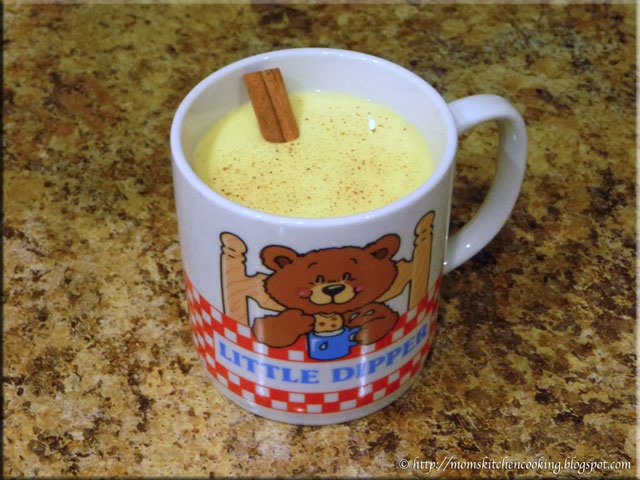
a small mug of eggnog ready to be enjoyed
Eggnog is either homemade (traditional, dairy free)  or commercially made.  Our traditional eggnog is made just like my Mom made using whole milk and raw eggs.  Whole milk has 150 calories, 8 g total fat, 35 mg cholesterol, 120 mg sodium, 400 mg potassium, 12 g carbohydrates (11 g sugar) in an 8 ounces.  It also provides Vitamin A (6%), calcium 30%, Vitamin C 4%, Vitamin D (25%) and phosphorous (25%).  The other major nutritional ingredient in homemade eggnog is egg yolk at 55 calories per yolk.  Each yolk also has 210 mg cholesterol for those wishing to avoid dietary cholesterol.   Sugar adds another 15 calories per teaspoon.  Stevia can be substituted for the sugar to reduce the sweetener calories if desired.  A 6 oz mug of homemade eggnog comes in at about 225 calories. 

A 6 oz mug of commercially made whole milk eggnog is about 270 calories.  It is higher in sodium, lower in potassium, has no Vitamin D and double in carbohydrates.  Commercially made eggnog also contains yellow dyes #5 and #6 as well as corn syrup and carrageenan (thickener).  There are concerns with the aforementioned, all of which cause health problems.  Chances are very good at holiday gatherings, the eggnog will be commercially made.   Since commercially made eggnog is higher in calories, lower in nutritional value and contains at least three ingredients that can cause health problems, it may be one of those holiday treats you decide to not indulge in.  Homemade eggnog is high in nutrition and taste, with none of the problems of commercially made eggnog.  However, homemade eggnog can be problematic for those who are lactose intolerant.

A few days ago I came across a dairy free coconut eggnog recipe that would suitable for those who are lactose intolerant or for those following the Paleo diet.  Coconut milk is substituted for whole milk.  While coconut milk is a great substitute for either purpose, it is not suitable for those restricting calories.  Coconut milk has 93 calories in 2 ounces or 279 calories in 6 ounces without the calories of the egg yolks and sweetener which would put a 6 oz mug of this eggnog in the 420 calorie range.  Coconut milk is however, very low in sodium content (9 mg/2 oz) and carbohydrates (2 g/2 oz).

Of the three options, avoid the commercially made eggnog if at all possible.  Be sure to add a sprinkling of nutmeg and a cinnamon stick.  Cinnamon adds flavour while increasing sugar metabolism which aids in weight loss because sugar is burned rather than converted to fat in the body.  Cinnamon is also beneficial for circulatory problems.  Nutmeg improves concentration, increases circulation and lowers cholesterol.   Eggnog is a delicious holiday tradition that you can still indulge in without the guilt even if you are restricting calories. 


Thursday, December 12, 2013

Hot Chocolate Baubles

Several years ago, I discovered clear glass Christmas bulbs that can be used for personalized baubles.  The first year I used a favourite picture of each of the kids printed on acetate for a very special Christmas keepsake bauble.  Each year I have used the clear baubles to create decorated baubles for gift giving and adding to our collection.  The clear glass baubles can be decorated in so many ways!

hot chocolate bauble ingredients
This year I discovered clear plastic baubles (88¢) at Walmart.  Unlike the clear glass version, the plastic bauble filled with candies or other seasonal dry goodies without the fear of breakage.  I also discovered Kraft Jet-Puffed Mallow Bits (dehydrated mini marshmallows), a new product that is perfect for gifts in jars or this purpose.  They are in the same aisle as the hot chocolate mixes not the aisle where the marshmallows are if you are looking for them.  I used Nestle hot chocolate packets for convenience but any hot chocolate mix including homemade can be used.  Each bauble uses 2 packets of hot chocolate mix.  I crushed a 100% natural candy cane to add that holiday sparkle to the mix. 

filling the hot chocolate bauble
Filling the baubles is not difficult but can be a bit tricky given their design.  There is no flat bottom so they won't stand up by themselves for easy filling.  I used a bowl to help steady the bauble for filling.   A funnel really helps with the filling to keep the layers neat and tidy.  A make-shift funnel can be made using a sheet of wax paper.  I poured two packets of the hot chocolate mix into the bauble.  I removed any hot chocolate powder film from the inside with a Q-tip.  There wasn't a lot but I like neat layers for these types of projects.  I added the mallow bits being careful not to disturb the hot chocolate powder.  I used a knife to help distribute the mallow bits.  Then I added crushed candy cane, not a lot, just enough to give the hot chocolate a holiday sparkle.  It's important to keep the bauble level so the layers don't mix together.

hot chocolate bauble ready for decorating
Once the bauble was filled, I added the curling ribbon bow.  This ribbon easily forms spiral curls when lightly pulled over the back of a knife or scissors.  It isn't expensive and comes in a variety of colours including prints.  Most dollar stores carry a good selection of curling ribbon.  With the ribbon in place, I added the bauble top and a piece of curling ribbon for hanging.  I was quite pleased with the results.  I'm sure the grandkids will be pleased to get their hot chocolate baubles!

The clear plastic baubles could be filled with: loose leaf tea, fruit and tea blends, candies, trail mix, dried fruit mix and so much more.  I recommend filling only half full and use light weight ingredients for the filling.  The bulk food store (eg. Bulk Barn) is an excellent source for fillings suitable for the baubles.  Depending on the recipient, you could also add a small toy if desired.  The limitation will be the size of the opening of the bauble which is about an inch.  Other than that, just let your imagination create a special unique gift for those on your gift giving list.  I hope you enjoy making these Christmas baubles!


Friday, July 05, 2013

Sodastream Jet Titan Starter Kit

We are not nor have ever been huge consumers of soda drinks.  By far the majority of soda purchased by us is for use when entertaining.  My husband enjoys Pepsi as an occasional mix for rye & coke but even there the choice tends to be half & half aka Arnold Palmer (half lemonade, half ice tea).   Once in a blue moon he will have a Mountain Dew.  I don't drink flavoured sodas.  My carbonated beverages of choice are club soda, Perrier and occasionally all natural ginger beer or sparkling grape juice.

I have moderate to severe year round allergies.  One of the most annoying symptoms is the insides of my ears and into the back of my throat intensely itching.  I don't take an antihistamine or leukotriene blocker unless absolutely necessary.  Both club soda and Perrier with the carbonation is one way I get relief but there is a catch to both.  Any soda in cans contains trace amounts of mold which isn't a problem for some but for folks like me who react to mold it is a problem.  Club soda is made with sodium bicarbonate which adds 20 mg to 85 mg of sodium per 355 ml serving, definitely not for those on sodium restricted diets.  Perrier is a carbonated natural spring mineral water.  All mineral waters can cause urinary tract problems.  Most sodas in general contain benzoic acid that can cause kidney stones.  Flavoured sodas are high in HFCS and/or sugar, artificial flavours and colourants, and calories.  In short, sodas are not a healthy drink of choice.  I wanted an alternative carbonated drink without a high sodium content and the option to flavour as desired so had considered a home soda machine for quite some time.

sodastream homemade soda maker
Canadian Tire is the best place to find kitchen appliances and other kitchen equipment on sale at rock bottom prices.  A couple of weeks ago they had three models of the Sodastream home drink makers on sale. These carbonating machines are tooted as being eco-friendly and they are in the sense the CO2 canister is exchangeable for refill and using the machines will greatly reduce soda cans and bottles BUT these machines are manufactured in Israel.  Shipping of these machines leaves a large carbon footprint that negates any environmental savings at the personal level.  Still, if one of these machines completely eliminated soda cans and bottles in the household it was being used in, over the lifetime of the machine, then I can see an environmental benefit. 

I bought the Sodastream Jet Titan starter kit ($109.99) that came with the machine, 1 L bottle (BPA free) and 60 L CO2 canister.  It also came with instructions and license for the canister.  Additional bottles are available in a 3 pack for $17.99 and should be changed out every 2 years.  The CO2 canister is $34.99 if you purchase a second one so you don't run out.  Empty canisters can be exchanged for $18.99 saving the core charge fee of $16.  The beauty of these machines is they are completely manual so are ideal to cart along camping or when traveling.  The CO2 canister are not allowed on airplanes either in carry-on or checked bags.  The machines and canisters are sold world-wide. 

sodastream flavoured syrup
Each CO2 canister will carbonate 60 L of water.  No other liquid should be used.  If paying for a full canister plus core charge ($34.99) the cost works out to 58¢ per L but using the exchange program, the cost is reduced to 31¢ per L.  To use, simply fill the bottle to the fill line with cold water then screw the bottle onto the machine.  Press the top button and quickly release three times.  You can add an extra press if you want the water a bit heavier carbonated.   Optional flavouring can be added after the water is carbonated.

Club soda comes in at 84¢ per L and Perrier is about three times that cost so if making simple fizzy water you will realize a savings.  Sodastream has a line of flavouring syrups in popular flavours at $6.99 for a 500 ml bottle.  Each bottle makes 12 L so this adds a cost per L of 58¢ so the total cost per L will range from 89¢ to $1.16 depending on whether you pay the core price for the canister or not.  A sampler pack of 12 Sodastream flavours is available for $11.99.  Syrups used for flavouring coffee (eg. Torani, Jordan's Slender Syrups) can be used as well as homemade flavourings.
 
lemon lime soda
Commercially flavoured syrups add cost but more importantly they add artificial sweeteners, colour and flavour, and calories.  Homemade sugar based syrups will also add calories but they can be made without artificial flavour or colour.  Vanilla syrup, a fruit syrup like peach syrup or an herb (eg. mint, lemon balm. lavender)  flavoured syrup can be used as flavouring. 

I used fresh squeezed lemon and lime juices to make lemon lime unsweetened soda.  This is a refreshing, sugar free, zero calorie drink I often make using club soda or Perrier that is similar in flavour to Sprite.  I like it without any sweetener but if you wanted it sweet without calories, adding a bit of stevia would work nicely.

The Sodastream is a frugal option for us.  I'm getting a healthier product that meets my needs without a high sodium content or ingredients that have the potential to cause more health problems.  I am saving a bit of money in the process and less waste will be going into the recycle bins.  So for us it is a win:win.   These machines are getting favourable reviews.  It is a great way to enjoy soda without all the additives and calories. 


Saturday, May 11, 2013

Cooking With Non-Alcoholic Beer

Throughout history, alcoholic beverages have played a large role in sustenance.  While widely consumed in beverage form, ethyl alcohol (grain alcohol) has several other uses.  Ethanol (ethyl alcohol) can be used to kill biological organisms (eg. bacteria, virii), something I learned during my lab days and continue to use in our home still.  It is used in the perfume and pharmacological industries.  I use a clear grain alcohol called Everclear (no flavour) to make homemade coffee liqueur and transparent soaps.  Many cough remedies, mouthwash and vanilla extract contain ethanol.  Any fermented foods (eg. yeast breads, sauerkraut, fermented pickles, wines) contain alcohol, a product of the fermentation process.  In fact, jams and jellies, orange juice and some sodas (eg. Mountain Dew) all contain very low levels of alcohol as a result of sugar conversion during storage.  Many processed foods contain added sugar alcohols (eg. sorbitol, xylitol, mannitol) as sweeteners but these are not true alcohols as found in the foods mentioned, although they are still cause for concern especially for those with diabetes.

Alcohol is commonly used in cooking to add flavour but can also be used as a food preservative.   Alcohol does add to the cost of the dish but normally there isn't enough added to greatly inflate the price of the dish.  the biggest concern is residual alcohol in the dish that remains after cooking and in the case of wine jellies the alcohol does not burn off at all.  For this reason, foods cooked with alcohol or using alcohol as an ingredient are not suitable for children, pregnant women or those choosing to abstain from alcohol.  While we do cook with alcohol, we do so on a fairly limited basis.  I have a couple of wine jellies that I make and I occasionally add some type of liquor to fruit preserves.  I use vodka or light rum to make vanilla extract.  A few years ago a friend introduced us to using a wine reduction sauce for grilled steaks.  On the very rare occasion I will add a dash of sherry to a dish.  Other than that, beer is the most common alcohol we use in cooking.  It is the secret to a great pizza dough and cheese sticks.  We use beer to make batter for English style fish & chips or coating vegetables.  I also like using beer when grilling brats and chicken.

Non-alcoholic beers are real beers (look, taste, fizz), brewed the same way as alcoholic beers but they undergo a final step to remove most of the alcohol leaving less than 0.5% ABV.  That means they retain all the flavour of the barley malt and hops that went into making the beer.  Most non-alcoholic beers are lagers but some are ales.  Using a non-alcoholic beer eliminates the worry of any residual alcohol in the food not burned out during the cooking process.  My concern after doing a bit of research was whether the non-alcoholic beers would give the same flavour because of some of the negative reviews regarding flavour.  as some beer drinkers in the forums indicated that the non-alcoholic beers were lacking in flavour, tasting watered down.  I reasoned that the lighter non-alcoholic beers would suitable for using in bread doughs, biscuits, fish or vegetable batters or for grilling while the darker, amber non-alcoholic beers with a deeper flavour would be a good choice for beef dishes and some beer breads.

I also found that non-alcoholic beers are not highly regarded with many commenting to the effect of 'why drink non-alcoholic beer because there is no point without the alcohol'.  Well, there are many reasons for choosing a non-alcoholic beer including religious and personal choice.  It has been shown that beer has several health benefits.  Those health benefits are still there in the non-alcoholic versions!  In all honesty the choice to use  non-alcoholic (de-alcoholized) beer is no different than choosing to use: decaffeinated coffee, sugar-free candy, no fat sour cream, soy based meat products, and margarine.

Non-alcoholic beers in Canada do have the nutritional value label on them just like any other food drink or beverage sold in the grocery stores.  Unlike beer that is sold in the government owned LCBO stores and The Beer Store, non-alcoholic beers and wines are available at the grocery store.  In fact, The Beer Store does not carry non-alcoholic beers.  I didn't check the LCBO but I doubt they carry them either.  To be labeled as non-alcoholic, the alcohol content must be 0.05% ABV or less.  So, a non-alcoholic beer can have up to 0.05% ABV which is the same amount of alcohol in a glass of fresh orange juice.

a few non alcoholic beers
There is a rather wide variety of non-alcoholic (de-alcoholized) beers but availability is very much dependent on location.  Pictured are five brands of non-alcoholic beer I found in our area.  There are at least two other brands that I am aware of.  Restaurants tend to stock only one brand of non-alcoholic beer if they stock any.  In our area of beautiful Ontario, some restaurants and pubs serve  O'Doul or Molson Excel.  Be sure to read the labels as non-alcoholic beers vary greatly. Some have sodium, some have protein, and some have iron.  They do vary in calorie content as well so if you are looking for a low calorie non-alcoholic beer, the best Our Compliments (35 calories per 355 ml) but it also has 10 mg of sodium so if on a sodium restricted diet, opt for one that has more calories but no sodium like President's Choice Blonde.  Some breweries add sugar to the de-alcoholized beer that gives it a sweeter flavour. 

Beck's (German brewed) non-alcoholic beer is 0.0% ABV and 60 calories per 355 ml bottle.  Our Compliments is brewed by Lakeport Brewing Company of London, Ontario is <0.05% ABV, 35 calories and 10 mg sodium per 255 ml can.  President's Choice Blonde (80 calories) and Rousse (100 calories) are <0.05% ABV, 0 mg sodium and brewed by Brick Brewing Co. in Waterloo, Ontario for the Loblaw's Company.  Molson Excel brewed by Molson-Coors Canada Ltd. is <0.05% ABV, 80 calories and 65 mg sodium. Of these non-alcoholic beers, the sodium content in Molson Excel could be a concern for some.  In terms of flavour, PC blonde and Our Compliments are quite smooth, nicely flavoured beers.  PC rousse is a darker amber colour, stronger flavoured beer.  Molson Excel has a nice enough flavour but is not as smooth and there is a distinct after taste.  Beck's has a mild flavour with a slight tang.  O'doul's does taste watered down in comparison to the other non-alcoholic beers I tested. 

Non-alcoholic beers are also available at our vacation home in sunny Florida as well as en route at the air port and some restaurants.  The grocery stores and Walmart in our area of Florida carry a variety of non-alcoholic beers such as Coors, Geneese, St. Pauli Girl, Busch, Beck's and O'doul's.  Unlike the Canadian non-alcoholic beers there is no nutritional value labels on the American versions however, limited information especially calories is available on their websites.  Of the ones I tested, Coors had the strongest flavour.

The same rule as cooking with alcohol applies for cooking with non-alcoholic (de-alcoholized) beer.  Do not cook with one you would not drink!  That means before cooking with a non-alcoholic beer, chill one to enjoy.  I have tasted all of these beers and was surprised that they are quite palatable, definitely worth keeping on hand for entertaining or enjoying those times where you don't want alcohol.   You might have to try a couple of brands before you find one you like but the good news is, the non-alcoholic beers are not expensive.  Some non-alcoholic beers like Our Compliments, President's Choice and Bush cost only 50¢ per 355 ml can.  Coors and St. Pauli Girl is about 90¢ per 355 ml bottle.  Beck's is the most expensive at $1.50 per 355 ml bottle.  So, for the most part, non-alcoholic beer costs less than soda.  The best thing is so far, I have found that the non-alcoholic beers perform exactly the same as beers that have the alcohol content.  I will be sharing the tasty results of cooking with non-alcoholic beers as I continue experimenting with them.


Tuesday, May 07, 2013

Extreme Green Juice

I have noticed is many turn their nose up at the idea of green juice.  It does have negative connotations.  One of the first comments I had after mentioning my new juicer was turning into one of 'them' and by 'them' the implication was a 'health nut'.  Juicing is a simple and healthy way that supports a healthy lifestyle but quite frankly you don't have to be a health nut to enjoy fresh homemade juices.  The benefit to having a juice extractor is you can easily make healthy fusion drinks.  I will say that I am so impressed with my juicer that I will be buying one for our vacation home.  It has quickly become a must have small kitchen appliance!

extreme green juice
While fresh homemade juices are healthier for you, some fruit and vegetable combinations act as detoxifiers or provide other health benefits besides tasting good.  One reason green juices get a bit of a bad rap is because they are made primarily of vegetables and herbs ergo they must taste like vegetables.  Now, certain vegetables (eg. cucumber, celery) make excellent juices by themselves.  Celery juice is a very good diuretic that will relieve temporary bloating without the side effects of a pharmaceutical diuretic.  Cucumber juice is a delightfully refreshing summer drink served over ice.  The surprising thing is, green juices do not have to taste like vegetables.  Extreme green juice is a delicious fusion juice consisting of fruit, vegetables and one herb.  We just won't tell anyone it's good for them!

Extreme green juice contains only four ingredients: celery, apple, broccoli and parsley.  It is a detoxifying juice that supports the liver, kidneys, immune system, nervous system and heart.  The diuretic effect of the celery helps flush toxins from your body, reduces urinary tract infections, and has anti-fungal properties to prevent fungal infections.  Celery also helps lower blood pressure and there is some indication that celery provides relief from migraines.  Parsley is an anti-cancer, anti-inflammatory agent that supports a healthy immune system and the heart while providing Vitamin K.   Broccoli helps maintain a healthy nervous system, regulates blood pressure, strengthens the immune system, boosts liver function and is rich in Vitamin C.  It supports healthy bones and helps repair sun damage while reducing the risk of atherosclerosis, heart attack, and stroke.  Apples fight the effects of aging on the brain and are rich in anti-oxidants and Vitamin C.  Fiber in apples provide a wide range of health benefits and while juice removes fibre, the juice strengthens the immune system while detoxifying the liver.  All in all, this is a very healthy drink that tastes delicious!

Extreme Green Juice

4 stalks celery
2 apples
1 small head (about 10 florettes) broccoli
handful fresh parsley

Wash and cut celery, broccoli and apples to fit in juicer hopper.  Juice adding ingredients until


Monday, February 11, 2013

Frugal Kitchens 101 - K-Cup Coffee Shops

Frugal Kitchens 101Single-brew coffee systems have become quite popular because they are convenient and save money.  Like many, I saw the immediate benefits of the single-brew systems especially for entertaining.  We bought a Melitta One:One single brew system that use pods quite similar to round tea bags only coffee.  We were quite happy with it even though it was difficult to find the pods in town but since we were in the US on a fairly regular basis, that wasn't a concern.  Then in early 2011 the Melitta started leaking sporadically gradually getting worse.  Compounding the problem, the pods for the Melitta were getting hard to find in the US as well, or at least where we shopped.  Finally, I had enough and replaced the Melitta with a Keurig single-brew coffee system.  Unlike the propriety pods for the Melitta with no option for using your own coffee, the Keurig had the My K-cup reusable filter system which would allow us to brew coffee using any ground coffee we wanted not just their K-cups.  In the event K-cups were no longer available, the system would still work until the appliance itself died.

I immediately started the cost analysis of the K-cups.  Each K-cup makes one 5.25 oz, 7.25 oz or 9.25 oz cup of coffee, tea, hot chocolate or other speciality drinks.  Depending on where you buy them, K-cups range in price from 35¢ to 79¢ which is a savings on $1.25 for a small take-out coffee and a considerable savings on speciality or gourmet coffees at coffee shops.  There's less waste produced with a K-cup and a lower carbon footprint as you don't have to drive to the coffee shop.  It's an added bonus to grab a favourite gourmet coffee and have it brewed into a travel mug just in time for heading out the door.  By far at 8¢ per cup, the My K-Cup filter with regular ground coffee bought on sale is the cheapest but it doesn't hurt to enjoy a favourite gourmet brew either.  The problem with some of the flavoured and gourmet coffees is you might not like them which has led to K-cup coffee shops which are becoming very popular because you get to sample the flavour of choice before buying a full package.

I just discovered one close enough to stop in when in that community.  The premise is you can pick a K-cup of your choice then have it brewed while sitting and enjoying the coffee shop or you can buy 6 or 30 mix-and-match K-cups or you can buy full boxes of one flavour of K-cups.  The one I went to charges $1.50 for a brewed coffee of your choice, $5 for a mix-and-match 6 K-cups (73¢ each), $22 for 30 mix-and match (73¢ each) and $16 for single flavour K-cups (66 ¢).  Be warned that they don't carry all variety of K-cups as the one we went to did not have any Folger's K-cups but they did have Starbucks.  Of note, if it is important to you, there was one K-cup (pink blend) with proceeds going to breast cancer research and several varieties that were Fair Trade.

Now, clearly the K-cup coffee shops are not cheaper per cup of coffee than Country Style or Tim Hortons BUT they are offering you a chance to taste test before buying a full box of that K-cup and they are giving you an opportunity to buy a wide variety of K-cups to taste test at home at a slightly lower price than you would pay for a full box of K-cups, single flavour, regular price.  The one we went to had sample K-cups of three of the brands that Sam's Club sells.  Sam's Club K-cups range in price from 43¢ to 56¢ but you have to buy a 80 pk which would really be annoying if you found you didn't like the taste of the coffee.  So if you have a chance to test out the coffee first, pay the extra at a K-cup coffee shop then if you like it buy it by the package on sale or at Sam's Club.


Friday, January 11, 2013

President's Choice The Great Canadian Single Serve Coffee Pod

My husband and I love our coffee.  By far we prefer coffee made in our vintage 1950's perculator which brews excellent coffee.  However, it is not convenient if only wanting to brew a single cup.  The Melitta Espresso & Cappuccino maker brews a lovely coffee but it is more for speciality coffees rather than daily use.  Several years ago, we bought a Melitta One:One single serve coffee maker that used round pods similar to Tetley tea bags.  The biggest problem we had was finding the coffee pods for the Melitta so when it started leaking, I splurged on a new Keurig single serve coffee maker in 2011.  As with our last house, the Keurig is one of two small kitchen appliances that have earned a place on the counter, never put into storage.

President's Choice The Great Canadian single serve coffee pods
I bought a My K-cup reusable filtering system for the Keurig with my initial purchase.  K-cups are expensive at about 80¢ per cup whereas using store bought or fresh ground coffee, the price goes down to 8¢ per cup.  My main concern with the K-cups has not been price, it has been waste.  The K-cups cannot go in the recycle bin although they can be emptied into the compost then the cup and foil top tossed.

K-cups are convenient.  I did find an online source that sold certain K-cups as low as 40¢ each and was happy with my order but after several high pressure emails followed by a multitude of spam from them, I won't deal with them again!  Sam's Club is the best price for K-cups followed by Bed Breakfast and Beyond but our local No Frills has been putting the K-cups on sale as well.  I was looking for a few extra K-cups for holiday entertaining and came across the President's Choice The Great Canadian single serve coffee pods.  A twelve pack was $4.99 (42¢) so I decided to try them even though I am a bit leery of cheap K-cups.  I brought back a package of Grove Square K-cups from Florida only to find out it's instant coffee!

comparison of K-cup to soft-bottom single serve pod
The President's Choice The Great Canadian single serve coffee pods are a unique soft-bottom single serve pod.  There is no hard plastic cup as in a K-cup (left).  If using a K-cup, it is placed in the K-cup holder then punctured top and bottom before the brewing process.  If using a My K-cup reusable filter system, the K-cup holder is replaced with the filtering system so nothing is punctured.  The soft-bottom pods are somewhat in between with the pod being placed in the K-cup holder but only punctured on the top.  Essentially, they are as convenient as K-cups, less expensive and have none of the mess of cleaning a reusable filter.  The box does indicate that the soft-bottom pods will work with most single brewers using Keuring Incorporated brewing systems but they are not affiliated with or approved by Keurig.  On the same note, I am aware of three other reusable systems other than My K-cup (Keurig) that can be used in Keurig systems that aren't affiliated or approved by Keurig.

K-cup and soft-bottom single serve pod after use
It's hard to get a picture of both puncture marks on the K-cup (left) but there is a puncture on the bottom as well.  Once the K-cup has been used the foil top can be removed and the coffee grinds put into the compost.  While there are many ways to reuse the actual plastic cup, in most cases they will end up in the waste because a lot of municipalities don't allow unmarked plastics in the blue bin.

The soft-bottom pod has only a puncture in the top and the bottom becomes firm as the coffee swells during brewing.  The foil top can be removed then pushing hard bottom to top the soft bottom and coffee will pop off the ring for the compost.  You are left with a small, plastic ring considerably smaller than the K-cup.  I'm sure I will come up with a few ways to reuse these rings but if tossing, they should be cut to prevent any problems with wildlife strangling.

storing K-cups and soft-bottom single serve pods
One of the biggest differences in the soft-bottom coffee pods is the package which overall is less than K-cups.  K-cups are usually kept in some type of rack right beside the brewer for easy access.  So you walk past the rack and all of a sudden want a coffee!  I usually buy K-cups in bulk from Sam's Club, occasionally buying a flavoured coffee on sale when I find it.  Neither of us are much into flavoured coffee but some of our guests are.  I have a couple of boxes and a plastic bin of K-cups so just restock the rack as needed.  However, the soft-bottom coffee pods cannot be stored in the rack for convenient use.  The reason being, there is nothing to stop the coffee from losing its aromatic flavour.

The soft-bottom coffee pods are packaged in a vacuum sealed, foil pouch inside a small cardboard box, both of which can be recycled.  The pods should be stored in the pouch, in the refrigerator for best flavour.  Another downside to the President's Choice soft-bottom coffee pods is the are only available in medium roast and west coast dark roast but both gourmet coffess made with 100% Arabica coffee.  I suspect they may introduce flavoured coffee pods but again, if you are looking for a nice alternative to K-cups, this coffee is good.


Wednesday, July 18, 2012

Summertime Fun - Frozen Drinks

During our recent vacation in Aruba, we rediscovered frozen drinks.  They are usually referred to as slurpies or slushies if non-alcoholic and frozen drinks if alcoholic here but in Aruba they are simply frozen drinks.  They are a very popular way to cool down there.  Although there were fancy frozen drink makers in the bars, the timeshares were equipped with standard blenders.  We were gifted with a Margaritaville Frozen Concoction Maker so I was collecting ideas for summer drinks while sitting around the pool.  The beauty of the frozen drinks is just about any drink can be made into a frozen drink easily and inexpensively by adding ice and blending until smooth and slushy.  There's no need to leave the comforts of your home or change out of swimwear to head to the local variety store or ice cream shop to pay the high prices for a frozen drink when it only takes a couple of minutes to make one at home.  Oh, and you can use chilled coffee as well which is a good way to use up the left over coffee from the pot you made in the morning.

frozen pina colada
We used the blender in Aruba to make Pina Coladas to take down to the pool area and the beach.  This is a nice, cooling drink that just so nice with blue skies and sandy beaches!  Traditionally, it is an alcoholic drink but you could make it a virgin drink by omitting the rum and adding a light splash of rum extract.  The following recipe is written for the Margaritaville Frozen Concoction Maker but can be modified to use a standard blender.
  
Pina Colada
source: Margaritaville Cargo Recipes

1¾ oz White Rum
3½ oz Pineapple Juice
1¾ oz cream of coconut

Fill ice reservoir with ice cubes.  Pour ingredients in glass blending jar.  Blend until smooth and creamy.  Pour into a goblet glass. Garnish with a slice of pineapple and serve with a strawberry (optional).

Kids love frozen drinks as well.  When the grandkids (ages 5, 4, 3) last visited for a pool party I wanted to make special frozen drinks for them.  I made raspberry lemonade then Papa turned it into frozen drinks for the little ones.

Raspberry Lemonade Frozen Drink
source:  Garden Gnome

1 can frozen lemonade concentrate
water
1 c fresh raspberries
3 - 4 mint leaves (optional)

Mix the frozen lemonade concentrate with the amount of water specified on the container.  Pour 4 c lemonade into blender.  Add ½ c of the raspberries and mint leaves.  Blend until smooth.  Pour into a large pitcher.  Repeat with the remainder of the lemonade and raspberries.  Pour that into the same pitcher and stir well.  This will give you about 64 oz of raspberry lemonade.

to make frozen drinks:  [concoction maker] Fill ice reservoir with ice cubes.  Pour raspberry lemonade in glass blending jar.  Blend until smooth and creamy.  [blender] Pour about 2 c of raspberry lemonade into blender.  Add several ice cubes.  Blend adjusting to get the right consistency with either more ice cubes or lemonade.  Pour into plastic drinking cups.  Add a straw and long handled spoon.


Thursday, November 10, 2011

Kitchen Quick Tips - Coffee Grounds and Tea Leaves

kitchen quick tips


Don't discard coffee grounds or tea leaves as both can be used to amend garden and houseplant soil.  Coffee grounds also provide natural insecticide properties.  They can be used as is then simply worked into the soil a little or put them in the compost bin.


Thursday, September 01, 2011

Kitchen Quick Tips - Frothing Milk

kitchen quick tips

Frothed milk is used for specialty tea and coffee drinks.  Skim milk froths better than 2% or whole milk.  It makes a stiffer foam without adding the fat of whole milk.  Whole milk makes a richer but higher fat froth.


Friday, July 22, 2011

My Keurig K-cup Purchase

A couple of days before leaving on our spring vacation in May, I spurged on a new Keurig single brew system to replace my rapidly failing Melitta One:One.  I promptly set up a new coffee centre making it easy and convenient to use the Keurig but did not have time to tweak the layout or even experiment.  When we arrived home from vacation, I had a lot of fun discovering my new toy!

The K-cups are expensive coming it at 79¢ each if bought on sale.  I bought the My K-cup re-usable filter system so we can use regular ground coffee (9¢ per cup), loose tea, tea bags and herbal tea at a fraction of the cost of K-cups.  I recycled a revolving spice rack for the K-cups rather than buying one of their carousels that would take up more counter space as it is wider.  I quickly realized that using the K-cups can be quite convenient especially when entertaining.  For example, out of twelve guests at the first get-together after returning home: one guest wanted decaf coffee, one wanted regular coffee and one wanted herbal tea.  I was able to quickly make these beverages without having to brew two pots of coffee, resort to instant coffee or get the tea kettle out.  The Keurig has quickly become the most used on a daily basis kitchen appliance we have.

I honestly don't mind cleaning the re-usable filter and we often run a couple of cups cleaning the filter in between rather than brew a full pot of purcolator coffee.  I decided that I would also like a good supply of K-cups.  I was contacted by a representative of One Cup Connection inviting me to check out their site.  [Note:  I have no affiliation with this company other than being a satisfied customer.  This is not a paid post.  The opinions expressed are my own.]

K-cup purchase
Their prices were the best I've seen yet at $11.99 for a 24 pack of K-cups in comparison to a sale price of $12.99 for an 18 pack (regular price $17.99).  I bough five cartons (120 K-cups) for a total of $45.96 that included free shipping and a free carton coupon code.  The price came in at 38.3¢ per K-cup less than half the cost of K-cups on sale in the stores.  Had I bought 5 cartons of K-cups on sale in the stores not only would I have less of a selection but it would have cost me $64.95 for 90 K-cups.  Other online sources (eg. Green Mountain) have raised their prices to almost $17 per 22/24 pack carton

Shipping is free if you buy at least $45 and they had a special if you bought 3 cartons you got one free.  They do have specials as low as $7.99 for K-cups past the best buy date and $9.99 for K-cups nearing their best buy date.  Their shipping time is really good, as low as 2 days.  They ship buy ground and unfortunately do not ship to Canada yet so I shipped to one of our US addresses.  

I bought Tully's Breakfast blend (nearing best buy date of August 14, 2011), Green Mountain Columbian Fair Traid Select, Green Mountain Caramel Vanilla Cream, Coffee People Donut Shop (Perks for the Planet) and Green Mountain Limited Edition Island Coconut Fair Trade.  Now 120 K-cups sounds like a lot but I'm sharing the order with our kids who also have a Keurig.  We will each have 60 K-cups which will likely last us well into the fall considering we both use the re-usable filter.  I really like that I can get Fair Trade Coffee in K-cups!  So my next order will reflect that.  I like that I can get flavoured coffees as well.  We don't use a lot of flavoured coffee but this is a way to be able to offer our guests other beverage options.  I will test out a couple of flavours as well.  All in all, my experience with One Cup Connection was quite positive.  I will certainly be ordering from them again!


Monday, July 04, 2011

Frugal Kitchens 101 - Coffee

Frugal Kitchens 101

A couple of weeks ago I caught a new segment warning of the rising price of coffee.  According to the segment the price of coffee is predicted to rise 98% before the end of the year.  That is a substantial increase that will have the highest impact on coffee drinkers who indulge on buying coffee at coffee shops but will also affect those making coffee at home.  Coffee prices at the coffee shops and restaurants range from included with a meal, to just over a dollar to as high as $6 or more for specialty coffee.  Coffee made at home ranges in price from about 5¢ per cup (brand name, on sale), 9¢ per cup (brand name coffee, not on sale), to as high as 79¢ for K-cups (Keurig single cup brewer).  This week's Frugal Kitchens 101 discusses some ways to save money on coffee. 

  • buy organic - Organic coffee is worth the extra expense because it eliminates pesticide and herbicide residues.  
  • buy fair trade if possible - Fair trade is a certification that indicates the producers are being paid fairly so they are able to provide themselves and their families with the necessities of life.
  • buy on sale - The rising costs of coffee will make it a loss leader in grocery stores.  A loss leader is an item sold below what it cost the grocery store to stock in the hopes that when you are in the store you will pick up a couple more items that the store will make money on.  An example of this is Maxwell House ground coffee was up to $10.48 per 926 g container at No Frills.  This past week, the same size container was on for $5 at Sobeys, limit of 3 per customer.  We bought six total that will help us ride out the rising prices for almost a year.
  • coffee shop loyalty - Tim Horton's is Canada's coffee shop chain and while their prices are reasonable they are still more expensive than coffee made at home.  However, ground Tim Horton's coffee is available at each of their coffee shops as well as in some grocery stores.  So you can enjoy your favourite coffee shop coffee at home.  It is more expensive than the regular brand name ground coffee at 34¢ per cup but about a third of the price of a small Tim Horton's coffee at the coffee shop.  Other larger coffee shop chains are selling their whole bean and ground coffee in their coffee shops and grocery stores as well. 
  • make coffee at home - If at all possible, make coffee at home.  The savings will be substantial allowing you to indulge in good coffee making equipment that will continue to save money for years to come.  Even if you don't want to take a thermos to work, there are now coffee bags much like tea bags at well under the price per cup of coffee shop coffee.  If your place of employment has a Keurig, Melitta One:One or Tassimo single serve coffee maker, buy your own K-cups or pods if you have to pay for the coffee there.  Bring a small can of coffee and the re-usable K-cup filter if there is a Keurig. 
  • splurge on the necessary equipment - If you enjoy coffee, buy good equipment that will last.  For example, we have: a Melitta espresso maker; Keurig single serve coffee/tea brewer, percolator, coffee grinder, specialty coffeeware, and travel mugs.  Pamper yourself a few specialty items like espresso cups, a French coffee press, and a good coffee grinder.  Put things in perspective as far as cost. Take-out coffee at $1.50 per cup, one per work day per year will cost $360.  That buys a lot of nice equipment and coffee but then the equipment continues to pay for itself saving you the cost of coffee shop coffee.
  • storage - Coffee beans should be stored away from direct light.  Ideally, coffee should be ground just before making the coffee for best flavour and aroma.  Don't grind more than you will use that day as coffee once ground quickly loses the essential oils for flavour.  Ground coffee should be stored in the refrigerator.  K-cups and Tassimo pods should be stored in a cool, dry location away from direct light.  One:One pods should be stored in a sealed, glass container in a cool, dry location away from direct light.


Sunday, May 15, 2011

Mini Keurig Coffee Maker

My apologies for a late post today but the reason why the post is late will be revealed at a later date.  I recently splurged on a new Keurig single serving coffee maker to replace the quickly failing Melitta One:One. After setting up the new coffee maker my first thought was this would be an ideal coffee maker for the workplace.  It would be quite easy for employees to buy their own K-cups then brew at work for a fraction of the cost of coffee shop coffee.  The K-cups are lightweight and easy to transport as well.  We left for the first part of our spring vacation to sunny Las Vegas the day after I bought the Keurig.  We used it that morning then unplugged it and we were off.

mini keurig coffee maker
Imagine my surprise when we checked into our room at the Golden Nugget to see a mini Keurig coffee maker!  There was a box of four K-cups beside the coffee maker.  The coffee was from Green Mountain so I figured I was going to put that box of K-cups into my suitcase to head home for a couple of our kids that like that brand of coffee.  We were traveling with another couple.  Thank goodness they pointed out that the box of four would be a room charge of $10.  Now I'm not stupid.  In Las Vegas there is no need to pay for any drink, alcoholic or otherwise so there was no way I was going to pay $2.50 per K-cup to enjoy coffee in my room.  I drooled over that coffee maker and the K-cups the entire trip then headed down to the casino for the customary Baily's and coffee before heading for breakfast.  The Baily's and coffee technically was free but I always tip $1 which I think is only fair when the waitress is doing be the favour of bringing me a free drink.

I have to say though that I am a bit disappointed.  We have stayed at the Golden Nugget several times and because we do a fair amount of traveling we know that many motel rooms have coffee makers complete with coffee packets free of charge.  It is nice to be able to enjoy a cup of coffee before putting on the day's face.  This is the very first time we have ever been 'charged' to have coffee in our room aside of room service.  On the higher end K-cups will come in at about 80 cents each so even at $2.50 each to use they were well overpriced.  The Golden Nugget is a higher end casino/resort.  This type of thing should be built into the price of the room if anything rather than an in your face money grab.  Don't get me wrong as the Golden Nugget treats us very, very good especially with respect to comps but somehow charging for coffee in the room is just wrong when you can go down and get one for free.