My photo
Ontario, Canada
I am a wife, mother and grandma who enjoys the many aspects of homemaking. A variety of interests and hobbies combined with travel keep me active. They reflect the importance of family, friends, home and good food.
Cook ingredients that you are used to cooking by other techniques, such as fish, chicken, or hamburgers. In other words be comfortable with the ingredients you are using.
--Bobby Flay

For Your Information

Please watch this area for important information like updates, food recalls, polls, contests, coupons, and freebies.
  • [March 19, 2020] - Effective Mar 17, this blog will no longer accept advertising. The reason is very simple. If I like a product, I will promote it without compensation. If I don't like a product, I will have no problem saying so.
  • [March 17, 2020] - A return to blogging! Stay tuned for new tips, resources and all things food related.
  • [February 1, 2016] - An interesting report on why you should always choose organic tea verses non-organic: Toxic Tea (pdf format)
  • Sticky Post - Warning: 4ever Recap reusable canning lids. The reports are growing daily of these lids losing their seal during storage. Some have lost their entire season's worth of canning to these seal failures! [Update: 4ever Recap appears to be out of business.]

Popular Posts

Monday, November 08, 2010

Frugal Kitchens 101 - Food in Uncertain Times (2)

Frugal Kitchens 101

It is true that we are living in trying economic times.  The sad thing is a lot of folk do not know how to go about securing a food source and even less so securing a sustainable food source to help get through the harder economic times.  Food banks and charitable organizations can only do so much so it is time for each individual to take responsiblity in establishing some type of a food stock that should at minimum be a 3 month supply.  As mentioned in the previous post my comfort level is a 12 month food supply but in reality it is an 18 to 24 month supply.  At the same time using a few new skills can greatly help with securing food.  This week's Frugal Kitchens 101 is an extension of last week's post where I focused on growing your own food.

A frugal homemaker should never have to resort to using a food bank or charitable organization (eg. soup kitchen) for their food supply.  Instead they will strive to have enough on hand to be able to help themselves and perhaps help others if the need arises.

  • couponing - If you use coupons when grocery shopping, take what ever savings and buy canned foods for your pantry.  It might not seem like a lot but everytime you add two or three cans to your pantry stock you are taking one more step toward preparedness.  While it isn't food sustainability it is one way to help getting towards that goal.
  • buy in bulk - Again you will be relying on commercial and local growing sources but this is necessary when first setting up a well stocked pantry and in come cases it will be the only way to stock certain foods.
  • grow your own - Grow as much food as you can yourself.  That includes growing indoors, outdoors, in urban and rural settings.  When it comes to vegetables focus on heirloom varieties so you can collect seeds to grow for the following year (sustainable).   Consider adding a protein source to the foods you grow.  More and more communities are allowing backyard chickens kept mainly for the eggs.  Rabbits are allowed pretty much anywhere including urban settings. 
  • barter - Trade your excess produce from your garden with another gardener who has an excess of another fruit or vegetable.  Produce can also be traded for eggs, honey, meat and maple syrup. 
  • learn new skills - Learning new skills like gardening, fishing, hunting, trapping and foraging can help to increase your food supply.  Learning new skills like canning, dehydrating and curing will help preserve some of your increased food supply for later use.  A surprising amount of food can be produced simply by growing your own but that can be easily supplemented with fish, hunting and foraging.  Foraging in particular may be as close as your own back door and a surprising number of edible weeds can be foraged in urban settings.   Preserving extra food is not difficult, expensive or time consuming but it is one of the best ways to add to your food stores.


Sunday, November 07, 2010

The Issue of Preservatives

If you have been following this blog you will know it is very much about making it at home if possible.  In most cases homemade is cheaper and in many cases the homemade product is healthier through less artificial flavours, colourants and preservatives.  So by all means and given the amount of home canning I do on a regular basis and given that home canning results in a healthier, less expensive product I am hesitant to to say that there are sometimes commercially canned may be the most frugal choice.

commercially canned dill pickles and olives
I grow a descent sized garden and what I don't grow I buy from local farmers, usually organic.  The past few years has been iffy with respect to pickling cucumbers.  At best I've managed to grow enough to make a good sized batch of freezer pickles. I've managed to siphon off enough for a batch or two of dill pickles but it has been really hard.  The real catch comes if I buy pickling cucumbers enough for 4 L jars I will pay around $8 which doesn't sound all that bad.  Except I can buy a 1 gal (a little over 4 L) for about $4 at Sam's Club.  In this case it makes sense to buy the jar from Sam's Club or does it? 

The Sam's Club jar contains sodium benzoate as a preservative.  Since the pickles will not be heated that isn't a concern but if they were heated sodium benzoate reduces to benzene, a known carcinogen.  The commercially canned pickles also contain polysorbate 80 (an emulsifier) and yellow 5.  While polysorbate 80 is not carcinogenic I question why it is there in the first place.  Yellow 5 is the food dye tartazine, an azo dye.  The problem with tartazine is it does cause allergic reactions especially in those sensitive or allergic to aspirin.  Tartazine is an asthma trigger and can cause outbreaks of hives.  As a person with allergies including food allergies suddenly that $4 jar of pickles does not look so appealing.  Well the jar looks rather good for later storage and the pickles will be used for those not sensitive.  In this case though the pickles were not a frugal choice.  Even though making my own would have cost more they would have resulted in a significantly safer product for those like me that are sensitive to food dyes and preservatives.

Sam's Club also sells premium olives in a two pack of 21 oz jars for about $5.  Since I have absolutely no ready source for raw olives I have no choice but to buy them.  The only preservative in the olives is potassium sorbate, the salt of sorbic acid.  Sorbic acid is an unsaturated carboxylic acid that occures naturally in some berries.  Potassium sorbate is a preservative used to inhibit molds and yeasts in cheese, wine, yogurt, dried meats, apple cide, dried fruits and baked goods as well as many personal care products.  It is aluse used as a wine stabilizer.  Potassium sorbate is non-irritating and non-sensitizing with allergic reactions being quite rare.  The olive contain no additional dyes or preservatives.  In this case the olives are a frugal choice for me. 

Now this is something to keep in mind.  If a product like the dill pickles have the potential to cause food related allergies they are best avoided entirely.  In this case the homemade version is the more frugal choice even if it ends up being more expensive.  On the other hand a product like the olives that is rather benign the commercial version is the frugal choice.  As a bit of an aside, many people experience side effects specifically from commercially canned foods than they realize.  Consider the person sensitive to tartazine, a couple of pickle slices might give a slight rash while a whole pickle might give a greater reaction BUT with allergies each exposure will give a stronger reaction.  So if you are looking for possible solutions to unexplained rashes, hives, or something similar start checking those food labels!


Saturday, November 06, 2010

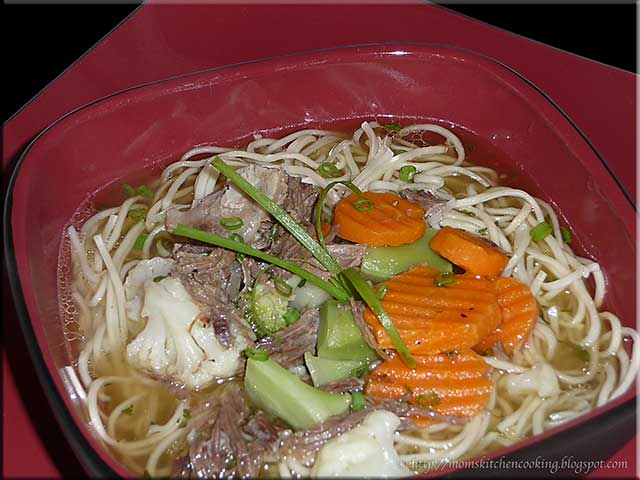
Beef Noodle Bowl

Pasta is just one of those foods that is so versatile there is some version in most cultures.  It is inexpensive, can be easily be made from scratch with only 2 or three staples or can be purchased commercially made quite inexpensively.  Wheat based pastas are very popular but there are rice and gluten free pastas available as well.  Pasta is just one of those foods most people enjoy and there are so many ways to enjoy pasta!

3
Chow mein noodles can be found in the Asian section of most grocery stores.  Chow mein noodles are one of the key ingredients for many Chinese dishes.  They are boiled for 3 minutes then used as is for soup noodles or stir-fried for chow mein.  Not only are chow mein noodles quick cooking the ones I bought are egg free with 0% sodium and cholesterol.  In comparison to other pastas they are lower in calories at 280 cal per 1½ pieces (85 g) verses 320 cal per cup (85 g) of gemelli.  The noodles are pressed into 8 squares.  A serving size is 1½ squares per noodle bowl so a package that cost $1.29 will give 4 servings but there may be more servings when used for other dishes. 

beef noodle bowls
On one of our many visits to the Greater Toronto Area (GTA) we discovered noodle bowls at a Chinese restaurant in Chinatown.  A rice bowl is somewhat like a soup but the focus is on the noodles so there is little in the way of other ingredients.  The broth which can be beef, chicken or pork is usually clear.  The noodles are cooked separate from the broth then placed in a bowl using tongs.  The noodles should fill the bowl by at least half.  A generous spoonful of a vegetable with or without meat mixture is placed on top of the noodles then hot broth is added just enough to show slightly around the noodles.

This is an extremely inexpensive dish to make.  I used 2 beef soup bones to make the broth in the pressure cooker.  

Broth

2 lg soup bones
1 lg carrot
1 sm onion
1 stalk celery
1 clove garlic
1 bay leaf
1 tbsp olive oil
12 c water
1 tbsp worcestershire sauce
salt and pepper to taste


Heat oil in pressure cooker bottom.  Brown soup bones.  Add all ingredients except worcestershire sauce, salt and pepper.  Place lid on pressure cooker.  Bring to pressure.  Reduce heat to just maintain pressure and cook for 30 minutes.  Remove from heat and allow pressure to come to zero.  Remove bones and cut meat from them, shredding and defatting as necessary.  Strain the broth.   Return broth to pot.  Stir in worcestershire sauce, salt and pepper.


Beef Noodle Bowl


1½ squares chow mein noodles per person
2 c broccoli, cauliflower, carrot mix
meat from broth
broth
parsley flakes
green onion


Cook the chow mein noodles.  Heat the vegetable mix and meat in the broth.  Stir in two good pinches of parsley flakes.  Spoon drained noodles into bowl.  The bowl should be about half full of noodles.  Top with a couple of spoons of the vegetable and meat mixture.  Ladle hot broth over the vegetable, meat and noodles until just visible through the noodles.  Sprinkle with a few slices of green onion.  Garnish with green onion spike.


Friday, November 05, 2010

Ugly Fries

Poutine is a truly Canadian dish, uniquely French-Canadian cuisine.  There are three key ingredients to good poutine.  They are white cheese curds, real gravy not packaged* or from a tin and fresh-cut fries.  When I first wrote about poutine I mentioned that some call this wonderful side dish ugly fries.  In reality ugly fries while they resemble poutine are quite a bit different.

ugly fries
The only thing poutine and ugly fries have in common is the basic concept of topping French fried potatoes with cheese and gravy.  In a flavour comparison poutine wins hands down.  The reason is three fold.  Fresh-cut fries form the base and if you've ever had fry truck fries you will know how much better they taste than the anemic, thin fast food fries.  The potatoes must be fried in pure lard for an authentic taste.  French-Canadian gravy is very dark and thick with the consistency of molasses.  True poutine uses fresh white, cheddar cheese curds.


In comparison, ugly fries (pictured) are closer to American Gravy Cheese Fries.  The fries are cooked from frozen.  The gravy quite often comes from a tin can or a powdered mix.  The cheese is usually shredded mozzarella rather than cheddar but in this case the cheese was a mixture of shredded mozzarella and cheddar.  While the taste is not authentic poutine, ugly fries are quite popular.

*Some in Quebec use a packaged vegan gravy by Warwick.  It is one of the best poutine gravy mixes available.