My photo
Ontario, Canada
I am a wife, mother and grandma who enjoys the many aspects of homemaking. A variety of interests and hobbies combined with travel keep me active. They reflect the importance of family, friends, home and good food.
Cook ingredients that you are used to cooking by other techniques, such as fish, chicken, or hamburgers. In other words be comfortable with the ingredients you are using.
--Bobby Flay

For Your Information

Please watch this area for important information like updates, food recalls, polls, contests, coupons, and freebies.
  • [March 19, 2020] - Effective Mar 17, this blog will no longer accept advertising. The reason is very simple. If I like a product, I will promote it without compensation. If I don't like a product, I will have no problem saying so.
  • [March 17, 2020] - A return to blogging! Stay tuned for new tips, resources and all things food related.
  • [February 1, 2016] - An interesting report on why you should always choose organic tea verses non-organic: Toxic Tea (pdf format)
  • Sticky Post - Warning: 4ever Recap reusable canning lids. The reports are growing daily of these lids losing their seal during storage. Some have lost their entire season's worth of canning to these seal failures! [Update: 4ever Recap appears to be out of business.]

Popular Posts

Showing posts with label ingredients. Show all posts

Monday, April 07, 2014

Low Calorie Brown Sugar Substitute

Sugar substitutes have been on the market for a number of years.   We don't use artificial sugar substitutes or products that have artificial sugar substitutes as an ingredient.  All of the artificial sugar substitutes can have a negative impact on health.  What many don't realize is artificial sugar substitutes can impede weight loss.  Although these sugars do not have any calories, the body still responds to them and studies have shown that the artificial sweeteners can trigger cravings that ultimately make you eat more than you normally would have.  If you want to lose a bit of weight, avoid the artificial sweeteners! 

ingredients for low calorie brown sugar
We switched from white granulated sugar to organic and raw sugars a few years ago.  I have substitute either with maple syrup, honey, agave, molasses or fruit (eg. medjool dates, banana, applesauce).  Last year I began experimenting with stevia, an herb.  I plan on growing stevia in the garden this year.  I don't use a lot of stevia but knowing I can use it in place of sugar to reduce the calories is nice.

Truvia Baking Blend is a blend of stevia, erythritol (natural sugar alcohol) and sugar that has 75% fewer calories from sugar.  It resembles granulated white sugar and like white sugar it adds sweetness and bulk but no real flavour.  There is no brown sugar substitute version.  The work-around if you need to substitute brown sugar with a lower calorie version and want to use stevia is to mix fancy molasses with Truvia Baking Blend.  By the way, this will also work using granulated white sugar if you find you are out of brown sugar for a recipe.
 
mixing the low calorie brown sugar
You will need Truvia Baking Blend, fancy molasses, a measuring cup, a measuring spoon and air tight storage container.  Measure 1 cup of Truvia Baking Blend into a small bowl with lid.  Pour 1 tsp of fancy molasses over the Truvia.  If you want to make a smaller or larger batch, use the ratio of 1 tsp fancy molasses to 1 c of Truvia.   Using a fork, mix the molasses into the Truvia until well blended.  It will resemble golden brown sugar in texture and flavour.  If you want a deeper brown colour and flavour, add an extra half teaspoon per cup fancy molasses.  This will also increase the caloric value slightly, about 12 calories per cup higher, but still less than the caloric value of regular brown sugar.

low calorie brown sugar
Store the homemade low calorie brown sugar substitute in an air tight container.  Substitute the amount of brown sugar called for in the recipe with half the amount of the low calorie brown sugar substitute.  For example, if the recipe calls for 3/4 c of brown sugar, substitute with 1/4 c + 2 tbsp of the low calorie brown sugar substitute.

Regular grown sugar has 829 calories and 214 g carbohydrates per cup or 52 calories and 13 g carbohydrates per tablespoon.  The low calorie brown sugar substitute has 403 calories and 101 g carbohydrates or 25 calories and 6 g carbohydrates per tablespoon.  The low calorie brown sugar substitute will reduce the calories from brown sugar by a little over half.  This sugar substitute can be use in place of brown sugar for many applications.  Be aware that although the low calorie brown sugar substitute is lower calorie, it does still contain sugar.


Monday, March 31, 2014

PB2 vs Peanut Flour

Peanuts are an economical high source of protein.  A few days ago I wrote about a long time staple in our pantry, PB2 (powdered peanut butter).  This product is simply mixed with water to make traditional peanut butter for spreading but because it is made with peanut flour, it is lower in calories due to the lower fat content.  As a result, although PB2 was intended as a high protein food for camping and survival, it has become extremely popular with the weight loss crowd. 

pb2 verses peanut flour
Both PB2 and peanut flour can be difficult to find.  I have yet to find a local source.  I have found PB2 in Michigan but not the peanut flour.  In fairness, I haven't checked a lot of stores there as I can easily order online.  So, which is the better value?

Peanut flour is made from dry roasted peanuts that are partially de-fatted then ground into flour.  It is gluten free and high in protein.  Peanut flour can be used as a thickener for soups, a flavourful and aromatic ingredients for baked goods, a creative coating for meats and fish, a tasty protein boosting addition for smoothies and it can simply be mixed with water for a low calorie spread.  PB2 is made from peanut flour, sugar and salt. 

Peanut flour is slightly higher in calories at 110 cal/4 tbsp verses PB2 that is 90 cal/4 tbsp and it is just slightly higher in fat (35 g vs 26 g).  However, peanut flour is considerably lower in sodium with 0 mg sodium verses the 118 mg sodium in PB2.  It is slightly lower in carbohydrates than PB2 (8 g verses 10 g) and higher in protein at 16 g verses 10 g protein in PB2.  Peanut flour works out to 1¢/g (31¢/oz) while PB2 is double that (2¢/gr [61¢/oz]).  I found the peanut flour in a 907 g (32 oz) package which is a bit more convenient size for baking than the PB2 that comes in a 184 g (6.5 oz) container.  In my opinion, peanut flour is the better choice in terms of value for your food dollar.  It is more versatile without the added sugar and sodium that PB2 has. 


Sunday, March 30, 2014

Alternative Flours

In my early teenage years eons ago, I was enthralled with a local hippie couple who occasionally drove their 'flower power bug' into town.  That was a time in our lives where my Mom had a small black and white television complete with rabbit ears that gave us three channels to enjoy.  By enjoy I really mean that the television came on Sunday nights to watch Lawrence Welk, sometimes on the weekend to watch Bill Kennedy at the Movies and few times during the holidays.  That's it!  There were commercials back then and I can recall Euell Gibbons promoting grape nuts in what my Mom referred to as 'hippy food'.  It really didn't matter because unless we went to the city, we wouldn't be able to get any kind of 'hippy food' in our tiny village!  In fairness Euell Gibbons was a proponent of natural diets in the 1960's.  Many of his ideals have simply been refined and tweaked but the focus for many of today's diet trends is on healthy, natural foods.  Fast forward to today's diet trends and honestly, I have no problem finding any food products they endorse.

Three current culinary trends are influencing the products offered by the food industry.  They are Paleo and Primal diets and gluten-free eating.  The Paleo and Primal diets have received a lot of attention in the culinary world.  The Paleo diet (aka cavemaan diet) is based on eating wholesome, existing foods that can only be foraged.  This included grass fed meats, poultry, fish, greens, seeds, regional fruits and vegetables, fungi, nuts, oils made from fresh produce and flours made from fresh produce (eg. nuts, fruits).  Foods not to be consumed on the Paleo diet are: cereal grains, legumes, dairy products, refined sugar, potatoes, table salt and refined vegetable oils.  The Primal diet is similar to Paleo but makes no restriction on saturated fats so butter, lard, full fat milk, cream, sour cream, cheese and chocolate are allowed. Gluten is a protein found in cereal grains.  It is responsible for the elasticity in doughs made with wheat, barley and rye.  True gluten is restricted to certain members of the grass family however those avoiding gluten will also not consume corn and rice which has a gluten-like protein.  About 1 in 133 in developed nations have a gluten intolerance or sensitivity (not allergy) however, many have restricted gluten from their diets on the basis of antidotal reports of the alleviation of certain gastrointestinal problems as a result of eliminating gluten.   As a result, the food industry has responded with a wide range of gluten free products and other products to meet the needs of Paleo and Primal diets.

alternative higher protein flours
You do not have to be on a Paleo or Primal diet, or eat gluten free or even be one of the multitude of various forms of vegetarianism to enjoy using these products.  Unlike some foods, products directed especially to the Paleo and Primal diets tend to be organic, preservative and additive free.  It is still possible to enjoy a wide range of baked goods simply by substituting white or whole wheat flour which is not permitted on either diet with another flour.

I bought a few alternative flours.  With the exception of the black bean flour, all are permitted on a Paleo or Primal diet and are gluten free.  These flours are a great way to boost the protein content in your home baked goods.  The protein content of unbleached white flour is 10 g/100g and whole wheat is 14 g/100g but they are not allowed if following a Paleo or Primal diet and they are not gluten free.  Almond flour is available as unblanched and blanched with a protein content of 21 g/100 g.  It is used for cookies, cakes and pancakes.  Chickpea flour has a protein content of 22 g/100g, black bean flour 22 g/100 g, coconut flour 20 g/100 g, quinoa flour 14 g/100 g and peanut flour 53 g/100 g.  Coconut flour is a dense flour so is substituted with 1/4 c for every 3/4c of grain flour and a little extra liquid is needed.  Quinoa flour is extremely popular for those on a Paleo diet due to its versatility.   I will discuss each of these in greater detail in future posts along with a few ways to use them.   

These flours as well as arrowroot flour and tapioca starch can be found at most health food stores, some larger grocery stores and online from sources like Vitacost.  Bob's Red Mill is a very popular brand of specialty foods like these alternative flours.  Be warned, if buying this way, the flours are expensive at $13 or more for 623 g (1 lb 6 oz).  Bulk Barn is selling the alternative flours at a more reasonable prices.  Our smaller Mom & Pop bulk food store and local health food store also has reasonable prices for some of these flours.  Most of the alternative flours can be made at home from the whole foods as well.


Saturday, May 11, 2013

Cooking With Non-Alcoholic Beer

Throughout history, alcoholic beverages have played a large role in sustenance.  While widely consumed in beverage form, ethyl alcohol (grain alcohol) has several other uses.  Ethanol (ethyl alcohol) can be used to kill biological organisms (eg. bacteria, virii), something I learned during my lab days and continue to use in our home still.  It is used in the perfume and pharmacological industries.  I use a clear grain alcohol called Everclear (no flavour) to make homemade coffee liqueur and transparent soaps.  Many cough remedies, mouthwash and vanilla extract contain ethanol.  Any fermented foods (eg. yeast breads, sauerkraut, fermented pickles, wines) contain alcohol, a product of the fermentation process.  In fact, jams and jellies, orange juice and some sodas (eg. Mountain Dew) all contain very low levels of alcohol as a result of sugar conversion during storage.  Many processed foods contain added sugar alcohols (eg. sorbitol, xylitol, mannitol) as sweeteners but these are not true alcohols as found in the foods mentioned, although they are still cause for concern especially for those with diabetes.

Alcohol is commonly used in cooking to add flavour but can also be used as a food preservative.   Alcohol does add to the cost of the dish but normally there isn't enough added to greatly inflate the price of the dish.  the biggest concern is residual alcohol in the dish that remains after cooking and in the case of wine jellies the alcohol does not burn off at all.  For this reason, foods cooked with alcohol or using alcohol as an ingredient are not suitable for children, pregnant women or those choosing to abstain from alcohol.  While we do cook with alcohol, we do so on a fairly limited basis.  I have a couple of wine jellies that I make and I occasionally add some type of liquor to fruit preserves.  I use vodka or light rum to make vanilla extract.  A few years ago a friend introduced us to using a wine reduction sauce for grilled steaks.  On the very rare occasion I will add a dash of sherry to a dish.  Other than that, beer is the most common alcohol we use in cooking.  It is the secret to a great pizza dough and cheese sticks.  We use beer to make batter for English style fish & chips or coating vegetables.  I also like using beer when grilling brats and chicken.

Non-alcoholic beers are real beers (look, taste, fizz), brewed the same way as alcoholic beers but they undergo a final step to remove most of the alcohol leaving less than 0.5% ABV.  That means they retain all the flavour of the barley malt and hops that went into making the beer.  Most non-alcoholic beers are lagers but some are ales.  Using a non-alcoholic beer eliminates the worry of any residual alcohol in the food not burned out during the cooking process.  My concern after doing a bit of research was whether the non-alcoholic beers would give the same flavour because of some of the negative reviews regarding flavour.  as some beer drinkers in the forums indicated that the non-alcoholic beers were lacking in flavour, tasting watered down.  I reasoned that the lighter non-alcoholic beers would suitable for using in bread doughs, biscuits, fish or vegetable batters or for grilling while the darker, amber non-alcoholic beers with a deeper flavour would be a good choice for beef dishes and some beer breads.

I also found that non-alcoholic beers are not highly regarded with many commenting to the effect of 'why drink non-alcoholic beer because there is no point without the alcohol'.  Well, there are many reasons for choosing a non-alcoholic beer including religious and personal choice.  It has been shown that beer has several health benefits.  Those health benefits are still there in the non-alcoholic versions!  In all honesty the choice to use  non-alcoholic (de-alcoholized) beer is no different than choosing to use: decaffeinated coffee, sugar-free candy, no fat sour cream, soy based meat products, and margarine.

Non-alcoholic beers in Canada do have the nutritional value label on them just like any other food drink or beverage sold in the grocery stores.  Unlike beer that is sold in the government owned LCBO stores and The Beer Store, non-alcoholic beers and wines are available at the grocery store.  In fact, The Beer Store does not carry non-alcoholic beers.  I didn't check the LCBO but I doubt they carry them either.  To be labeled as non-alcoholic, the alcohol content must be 0.05% ABV or less.  So, a non-alcoholic beer can have up to 0.05% ABV which is the same amount of alcohol in a glass of fresh orange juice.

a few non alcoholic beers
There is a rather wide variety of non-alcoholic (de-alcoholized) beers but availability is very much dependent on location.  Pictured are five brands of non-alcoholic beer I found in our area.  There are at least two other brands that I am aware of.  Restaurants tend to stock only one brand of non-alcoholic beer if they stock any.  In our area of beautiful Ontario, some restaurants and pubs serve  O'Doul or Molson Excel.  Be sure to read the labels as non-alcoholic beers vary greatly. Some have sodium, some have protein, and some have iron.  They do vary in calorie content as well so if you are looking for a low calorie non-alcoholic beer, the best Our Compliments (35 calories per 355 ml) but it also has 10 mg of sodium so if on a sodium restricted diet, opt for one that has more calories but no sodium like President's Choice Blonde.  Some breweries add sugar to the de-alcoholized beer that gives it a sweeter flavour. 

Beck's (German brewed) non-alcoholic beer is 0.0% ABV and 60 calories per 355 ml bottle.  Our Compliments is brewed by Lakeport Brewing Company of London, Ontario is <0.05% ABV, 35 calories and 10 mg sodium per 255 ml can.  President's Choice Blonde (80 calories) and Rousse (100 calories) are <0.05% ABV, 0 mg sodium and brewed by Brick Brewing Co. in Waterloo, Ontario for the Loblaw's Company.  Molson Excel brewed by Molson-Coors Canada Ltd. is <0.05% ABV, 80 calories and 65 mg sodium. Of these non-alcoholic beers, the sodium content in Molson Excel could be a concern for some.  In terms of flavour, PC blonde and Our Compliments are quite smooth, nicely flavoured beers.  PC rousse is a darker amber colour, stronger flavoured beer.  Molson Excel has a nice enough flavour but is not as smooth and there is a distinct after taste.  Beck's has a mild flavour with a slight tang.  O'doul's does taste watered down in comparison to the other non-alcoholic beers I tested. 

Non-alcoholic beers are also available at our vacation home in sunny Florida as well as en route at the air port and some restaurants.  The grocery stores and Walmart in our area of Florida carry a variety of non-alcoholic beers such as Coors, Geneese, St. Pauli Girl, Busch, Beck's and O'doul's.  Unlike the Canadian non-alcoholic beers there is no nutritional value labels on the American versions however, limited information especially calories is available on their websites.  Of the ones I tested, Coors had the strongest flavour.

The same rule as cooking with alcohol applies for cooking with non-alcoholic (de-alcoholized) beer.  Do not cook with one you would not drink!  That means before cooking with a non-alcoholic beer, chill one to enjoy.  I have tasted all of these beers and was surprised that they are quite palatable, definitely worth keeping on hand for entertaining or enjoying those times where you don't want alcohol.   You might have to try a couple of brands before you find one you like but the good news is, the non-alcoholic beers are not expensive.  Some non-alcoholic beers like Our Compliments, President's Choice and Bush cost only 50¢ per 355 ml can.  Coors and St. Pauli Girl is about 90¢ per 355 ml bottle.  Beck's is the most expensive at $1.50 per 355 ml bottle.  So, for the most part, non-alcoholic beer costs less than soda.  The best thing is so far, I have found that the non-alcoholic beers perform exactly the same as beers that have the alcohol content.  I will be sharing the tasty results of cooking with non-alcoholic beers as I continue experimenting with them.


Sunday, April 07, 2013

Let's Talk About Homemade Bread

Making homemade breads has been a regular practice in our home since our newlywed days.  I am always excited to discover a new bread recipe or breadmaking technique like the no-knead crusty bread baked in a cast iron Dutch oven.  There is no doubt about it, the tantalizing aroma of bread baking is a true delight.  Enjoying a slice of homemade bread still hot from the oven slathered with butter is a divine culinary experience!

The question with respect to homemade bread aside of the pleasure it brings and that cannot be discounted, is "Is making bread frugal?"  In this context I am using frugal to encompass cost, savings, quality, time and social responsibility.  Mixing of the dough takes almost no time.  At one time, bread was made from scratch and hand kneaded but the home cook no longer has to spend a long period of time kneading dough thanks to stand mixers, bread machines and even some food processors all of which make short work of kneading the dough.  So the dough can be ready for proofing in less than 10 minutes.  The real time comes from the proofing and baking.  There usually are two proofings (allowing the dough to rest while doubling in size) which develop the gluten in the flour.  Bake time is usually around the 40 to 50 minute mark.  A bit of planning ahead is needed then if you want a fresh loaf of bread for dinner.  However, there are no-knead breads that proof over night and a novel 5-minute a day bread that I will share my experiences with shortly.  In reality, the proof times are simply that with nothing for the home cook to do other than wait for the dough to double so other things can be done during that time frame.

Iingredients in Prairie Flour Mils LTD white flour
Let's consider the flour used for baking bread.  Canadian flours have a higher gluten level than American flours so it is quite easy for us to get a beautiful loaf of homemade bread with little effort.  Now, a few days ago I was doing a bit of research when I came across a video where the home cook claimed the only thing in their homemade bread was flour, salt, water and yeast yet they named the brand of flour they had used.  Wheat flours in North America are enriched.  That means they contain niacin, thiamin mononitrate, riboflavin, folic acid and iron.  They also contain azodicarbonamide (ADA) which is an oxidizing agent that may or may not act as a bleaching agent while strengthening the dough.  Malted barley is also an oxidizing agent that results in a strong dough.  Unbleached flour contains ADA because it improves the quality even though the mill may not be technically using it as a bleach.  The bottom line is, ADA is in both bleached and unbleached wheat flours.  Benzoyl peroxide is actually used to treat acne but it is also used as a strong bleaching agent for flour.  Flour bleached with benzoyl peroxide has been prohibited in the UK since 1997.  L-cysteine hydrochloride is a reducing agent that breaks the protein structure in the flour resulting in a stronger dough, reduces mixing time, reduces proofing time and increases machinability.  Unless you can find organic flour with no additives (rather difficult even in Toronto) or grind your own flour from whole grains, the flour you use will contain additives.  Prairie Flour Mills Ltd. has an organic flour with no additives but it is difficult to find.  No name flour contains the same ingredients but also has amylase, an enzyme that improves processing characteristics by breaking down the sugars to allow the yeast to act quicker.

In our little corner of Ontario, Canada we can buy the following brands of flour:  Prairie, No Name, Golden Temple, Robin Hood and Five Roses, all made with hard wheat (high gluten).  Prairie is milled by Prairie Flour Mills Ltd. which is owned, operated and supports the wheat growers of Manitoba.  A 10 kg (22 lb) bag of Prarie is $7.97 or 8¢ per cup.  Of note, Prairie Flour Mills Ltd., distributes under their own label (pictured above) as well as private label meaning a company can get the Prairie milled flour but sell it under their own private label.  No Name brand  is owned by Weston Foods and sold through their Loblaws division.  A 10 kg (22 lb) bag of No Name flour costs $9.97 (10¢ per cup).  Chances are the No Name flour is milled by Prairie Flour Mills Ltd. but sold under the private label of No Name.  If so, the higher price is simply to cover the cost of the private label.  Golden Temple is $10.89 for 9 kg (20 lb) or 12¢ per cup, Robin Hood and Five Roses are $13.97 for 10 kg (22 lb) or 14¢ per cup.  Golden Temple, Robin Hood and Five Roses were Canadian owned and they still are made with Canadian wheat but they are now owned by Smucker Foods of Canada, a subsidiary of US owned The J.M. Smucker Company.  There are also several smaller flour mills some of which are organic and non-GMO within the 100 mile radius of our home so I do take advantage of buying directly from them.

Of these brands, all use Canadian wheat so at some level support the Canadian wheat growers.  The No Name brand can be iffy.  The premiss behind the No Name label and this applies to any food with that label is, Weston Foods who owns Loblaws uses whatever they can get the cheapest to pass on the savings to their customers but they don't always disclose the origin so there is no guarantee that the No Name flour is made with Canadian wheat but I suspect it likely is, and probably made by Weston.  Canada has strong labour laws, high minimum wages and wheat boards so the wheat growers are paid fair compensation while workers enjoy decent working conditions earning enough to enjoy a comfortable lifestyle.
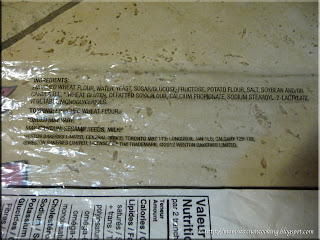
ingredients in D Italiano Italian style bread
Weston Food's bakery division is Weston Bakeries Limited founded by George Weston in 1882 and still controlled by the Weston family.  It produces a wide variety of baked goods including the popular D'Italiano breads.  Pictured is the label from the D'Italiano Italian style bread.  This is where the chemical components of the ingredients show for commercially made breads.  The label is a bit misleading as the ingredients in the flour (niacin, thiamine mononitrate, riboflavin and folic acid) are not listed in the ingredients although they are included in the nutritional information.  Many bread manufacturers do include the flour ingredients along with the list of other ingredients.  Of note is the canola oil which is definitely GMO!  Calcium propionate is a bacterial and mold inhibitor (aka preservative) which extends the shelf life of the bread.  Sodium stearoyl-2-lactylate is a salt that is used as an emulsifier/plasticizer/surface action agent to ensure consistent product qualtity.  This wonderful cocktail of chemicals only costs $2.27 for a 675 g (1.5 lb) loaf of bread.

ingredients in Walmart bakery Italian style crusty bread
Our Walmart has a bakery section for their fresh baked in store bakery goodies.  Most of their loaves of bread are $2.97 except their crusty Italian and French style that are only 97¢ for a 400 g (.88 lb) loaf of bread.  They are good at including some of the ingredients that are in the actual flourlike ADA but make no mention of the B vitamins or iron.  Ascorbic acid (Vitamin C) is a reducing agent similar to L-cysteine hydrochloride that strengthens the dough and the development of the gluten. Of not is the canola oil which is GMO and the 'contains: milk, wheat, rye, soy" and the 'may contain: tree nuts, peanuts, egg, sesame".  This is especially important for those folks who have food sensitivities to or who are allergic to any of these ingredients. 

crusty bread cut
Let's talk homemade bread!  

A small bakery opened up in town a couple of years ago.  This was a bit abnormal in a time when many small town bakeries have been closing up shop.  I checked it out always looking for ideas and more than willing to buy a loaf or two to duplicate at home.  At first, I didn't think they would stay in business with an average price of $3 per loaf of bread but they seem to be hanging in there and at only a couple of pennies per loaf more than the Walmart bakery and some brand names, there may be hope for this bakery after all. What this bakery has going for it is the bread is about as close to homemade as you can get without making it yourself. 

Homemade breads can save you a substantial amount of money.  While Walmart's Italian style crusty bread (.88 lb) only cost 97¢, my homemade no-knead version cost a total of 29¢ for a 1.5 lb loaf of bread, almost twice the weight of the Walmart bread saving me in essence over $1.50 on one loaf of bread.  Compared to the D'Itananio, (675 g/ 1.5 lb) I saved $1.98.  At three loaves of bread per week and saving at least $1.50 per loaf of bread, it works out to an annual savings of $234.   

In terms of quality, homemade bread is far superior to mass produced breads.  Did you know that bakery and homemade breads are so popular in the Netherlands they don't even have mass produced breads?  Instead they bring in artisan breads from Germany daily to stock the many bakeries.  That says something about the quality and popularity of artisan breads!  I use enriched unbleached flour for any white breads or any breads requiring a portion of white flour that I make.  That means my breads do contain all the additives (ADA, niacin, thiamin mononitrate, riboflavin, folic acid and iron) that are in the enriched flour.  The exception is when I have access to organic, additive free, unbleached flour. I also use dough enhancers (lethicin, gluten flour) from time to time but not on a regular basis.  Other ingredients that I may add tend to be organic, in the case of eggs they are free range, salt is sea salt not iodized, and I prefer using local raw honey, maple syrup, molasses or rice syrup as a sweetener over refined sugar.  If I do use sugar, it is organic.  Unlike some commercially baked breads, my homemade breads have no preservatives or added emulsifiers.  A surprising number of brands of whole wheat and whole grain breads contain artificial flavours or colours and they are HFCS free.  My whole wheat and whole grain breads contain none of these.  My fermented breads (eg. sour dough, crusty breads) develop a natural tang that eludes store bought breads, much more like what you would find in an artisan bakery.

Making your own bread is one of the most frugal things you can do in terms of quality and cost.  You need only a mixing bowl, a baking sheet and/or bread pan, the ingredients and your hands to make good bread.  Both a stand mixer and breadmachine take a lot of the work out of making bread.  The cost of both either can quickly be recovered in the money you save not buying store bought breads.  A Dutch oven is nice is you want to make crusty bread or rolls.  An inexpensive one new will cost about $40 on sale but these are also common yard sale and resale store finds for around $5.  The ingredients for making good bread are inexpensive and simple ranging from only flour, salt, yeast and water to a few other low cost additions if desired.  Even using organic, additive-free flour that is more expensive will still save you money while putting a far superior bread on your table in comparison to mass produced breads.  There are many ways to reduce the actual hands on time it takes to make bread but really most of the time involved with bread-making is waiting for the dough to rise.   At any rate, if you have not tried making your own bread, now is the time to start.  You will be pleasantly surprised!


Tuesday, September 11, 2012

Low Sugar Peach Jam

One of the final products I made while canning peaches was a low sugar peach jam using Pomona's pectin.  Pomona's pectin is a low methoxy pectin that uses calcium water for it's gel rather than sugar.  This means I can greatly reduce the amount of sugar used in a recipe or I can substitute some or all the sugar with honey or maple syrup.  Artificial sweeteners can be used with Pomona's pectin but we don't use these types of sweeteners so I can't tell you how well the work.  The best thing about Pomona's pectin is I can create my own recipes for jams and jellies as well as make gummy candies unlike using other types of traditional pectin (eg. Certo). 

low sugar peach jam
I make a fair number of jams and jellies yet very few are ever used as a spread.  Instead they are used as glazes or as an ingredient for baking and appetizers.  Most jams and jellies pair nicely with cream cheese and brie so the possibilities are endless. They are also great stirred into homemade plain yogurt.

Low sugar peach jam has all the gourmet flavour of peach jam made with Redpath QUICKSET, just less sugar.  The colour is a bit lighter but that could be due to the lemon juice that was added.  It is a delicious jam sure to please whether used as a spread or ingredient, a lovely addition to your pantry.

Low Sugar Peach Jam
recipe by:  Garden Gnome

4 c prepared peaches
¼ c lemon juice
2 c sugar
3 tsp Pomona's pectin
4 tsp calcium water
dab butter (optional)

Wash, skin and pit peaches.  Put in food processor then pulse until desired consistency leaving just a few larger pieces of peach.  Measure out 4 c.  Pour into large stainless steel saucepan.  Add calcium water and lemon juice.  In a separate bowl measure sugar and pectin.  Mix well.  Bring the fruit mixture to a boil.  Stir in the sugar mixture.  Stir to dissolve.  Return to boil.  Remove from heat. Stir in butter.  Ladle into hot jars.  Adjust two piece metal snap lids (or Tattler reusable lids or glass inserts).  Screw bands on jars (adjust accordingly if not using metal snap lids).  Process for 250 ml for 10 minutes in BWB canner at altitudes up to 1,000 feet above sea level.  At higher altitudes refer to altitude adjustment chart on Canning FYI page.  Remove from canner.  Adjust bands if using Tattler or glass inserts.  Allow to cool 24 hours.  Remove bands and test for seal.  Wash and dry bands and jars.  Label and store.


Thursday, December 15, 2011

Kitchen Quick Tips - Baking Powder

kitchen quick tips

Baking powder loses its potency over time so it is best to buy in smaller containers.  To test if the baking powder is still good, pour ½ tsp of baking powder into ⅓ c of hot water.  If it bubbles vigorously then the baking powder is still good to use. 


Thursday, December 30, 2010

Kitchen Quick Tips - Measuring Boiling Water

kitchen quick tips

Some recipes call for a specific amount of boiling water to be added.  Boil the water first then measure out the amount needed.  If you measure the water before boiling it can lose as much as an ounce when coming up to a boil through evapouration.


Wednesday, September 08, 2010

Pomona's Pectin

[Note:  I have no affiliation with Workstead Industries or Harvest Plus other than being a satisfied customer.  The following summary of Pomona's pectin is my opinions only.]

Many of the jam and jelly recipes I make do not use regular pectin (eg. Certo liquid or powdered) but rather use Pomona's pectin, a topic of a recent Frugal Kitchens 101.  Pomona's pectin is not readily available in most stores but can be found Amish and Mennonite country stores, natural/health food stores or can be ordered online directly from them through Workstead Industries (US, International) or Harvest Plus (Canada).   It is available in smaller packages as well if you don't want to commit to buying a larger quantity.

Pomona's pectin is a citrus based, low methoxy pectin that unlike other pectins does not require sugar to gel.  With regular pectins the fruit to sugar ratio is critical so you cannot substitute the sweetener or reduce it otherwise the jam or jelly will not set.  Pomona's pectin instead relies on calcium water.  When you buy Pomona's pecting (mason jar) it comes with a small packet of monocalcium phosphate.  The calcium water (blue arrow) is made by mixing ½ tsp with ½ c of water.  Once the calcium water is made it can be stored in the refigerator between uses where it will last for several months.  Shake before use.  If the white settled powder in the jar discolours, discard it and make a fresh solution.

Pictured is my remaining supply of Pomona's pectin and monocalcium phosphate.  The pectin is over a year old which is fine as this pectin has no expiry date, making it ideal for long term storage.  I'm about halfway through the 1 lb I purchased and am getting ready to place another order simply to avoid a price increase.  One pound equals 128 tsp at a total cost of 37.5¢ per tsp.  Most batches of jams or jellies that I make use 2 tsp of the pectin which works out to 64 batches of jam or jelly.  Syrups take half the amount and jelled candies take double the amount.

It is very important to understand that in the recipes where I specify using Pomona's pectin that I have developed that recipe specifically for that pectin.  You cannot substitute with other pectins.  There are a few recipes in the archives that use regular pectin.  In my opinion Pomona's pectin is a valuable, must have addition to my canning supplies.  Not only is this pectin cheaper than regular pectins, it give me the flexibility for creativity when making jams and jellies.  It can also be used to thicken homemade yogurt, syrups and make jelled candies (eg. gummy bears).


Wednesday, May 19, 2010

Dark Chocolate

I'm sorry but I am not a chocolate lover by any stretch of the imagination.   Yes I am female but chocolate really doesn't do it for me.  In fact for many years I avoided chocolate like the plague.  Over the years everyone in our family knew chocolate was not not going to be a featured ingredient in any dish I made.  Then one day one of our kids said maybe it wasn't the chocolate taste that I didn't like it was the mouth feel of milk chocolate and suggested I try a dark chocolate.

dark chocolate
The main problem appears to be my adverse reaction to milk chocolate.  For that reason I avoid mild chocolate at all costs.  I picked up a bar of dark chocolate and oh my gosh it is good.  It still is not something I would eat much of but it is something I would use as a garnish or in cooking.  The higher the cacao per cent the better for a deep, rich flavour of chocolate.

Dark chocolate is more expensive than milk chocolate.  Expect to pay $3 for a 100 g bar on the low price end to $36 on the higher end organic dark chocolate (Landies).  Dark chocolate is actually good for you.  It is high in anti-oxidants.    A recent study published in the European Heart Journal a 1 - inch square of dark chocolate can lower your blood pressure and reduce your risk of heart attack.  Now you have a good excuse to indulge in chocolate!


Monday, June 29, 2009

Frugal Kitchens 101 - Ingredients

Frugal Kitchens 101
By popular demand the Frugal Kitchens 101 will remain a regular feature of this blog. Thanks so much to all who voted. You're input is greatly appreciated!

If you have been following this blog for any length of time you will notice that I do specify certain types of ingredients. Mind you this is very different that ingredient brands. A couple of weekends ago we hosted a larger event and one of our long time friends asked me about my choice of sugar. I did not give a full answer at the time due to other distractions so I'm going to address this issue in a bit more detail here. I know she reads this blog so will see the answer.

To me frugal means getting the very best value for your money. In some cases this means you might have to pay a bit more but the additional cost is worth it. In other cases it means you simply will not compromise on what you want. Yet again it also means saving money and in our case it means being eco-friendly. If I specify a type of ingredient (eg. white vs unbleached flour) or a brand it is because there is a specific reason for using that ingredient. It means that is a superior ingredient that while it might cost a bit more in some cases it is well worth it. So here are the explanations for some of the ingredients I insist on.

  1. organic/hormone free beef - We buy beef on the hoof that is organically raised and is hormone free. On average we pay $2.50 per lb across all cuts so while we pay more for ground beef we are paying significantly less for roasts and steaks. Organic means the farmer is using good animal husbandry practices including refraining from using hormones like GTH. In this case the price of our beef is cheaper than store bought yet far superior and we are supporting local farmers.
  2. free range eggs - I don't think I've ever really specified the eggs I use other than saying I buy them from a local farmer. Again we are supporting local farmers. Depending on the price of store bought eggs I save 25¢ and more per dozen by buying higher quality eggs.
  3. organic vegetables - I try to grow as much as I can then shop for the rest. I'm very lucky that we are smack in the midst of farmland. Last year a nearby certified organic orchard was selling their produce 10 - 20% less than the chain grocery stores!
  4. sea salt - Regular table salt is iodized and may contain fillers to help keep the salt free flowing. Both will interfere with the canning process causing clouding and possible discolouration in some homecanned products. I honestly feel that natural sea salt is better for you. We use a salt mill to grind non-iodized salt for table use and I use bulk non-iodized sea salt for canning and cooking. Sea salt has a milder flavour that adds a sparkle without the harshness of regular iodized table salt and you really do need less. In terms of cost sea salt is more expensive than regular salt.
  5. organic sugar - Organic sugar means from start to finish the sugar is organic - no pesticides, no herbicides and no bleaching. Organic sugar does look a bit different in that the grains are not sparkly white and that is because the molasses has not been bleached out. It gives organic sugar a richer, deeper flavour somewhat in between white sugar and light brown sugar but it is a flavour not just a sweetness. Organic sugar does cost more depending on where you buy it with Sam's Club being the cheapest.
  6. unbleached flour - White flour (aka bleached flour) has to be one of the worst things you can put in your body. First bleached flour has been stripped of all nutrients leaving basically calories. Second it contains alloxan, a contaminant that can cause diabetes. Years ago when I switched to unbleached flour it was difficult to find. Now nofrills® in Canada sells a 10 kg (22 lb) bag of unbleached flour for the same price as bleached flour so it really becomes a matter of personal choice.
  7. local honey - Local honey is a must for anyone with allergies. The reason for this is the person has already been exposed to local allergens so is less likely to react to the local honey. At the same time local honey is not pasteurized so you are getting a far superior product. Prices will vary depending on the beekeeper and time of purchase but it general local honey is slightly cheaper than store bought.
  8. butter - Butter is a natural dairy product. It packs a lot of flavour to any dish but that doesn't mean you have to use a lot. I use butter as an accent and for cooking certain dishes. You can even make ghee from the butter to use for flavour without the milk solids. In general I use salted butter for regular use and unsalted butter for baking
  9. pure vanilla extract - I firmly believe you cannot make quality tasting anything using artificial ingredients! Pure vanilla costs a bit more but you use less and the flavour is top notch.
  10. ClearJel - This modified corn starch is currently the only approved thickener for canning. This is the non-instant ClearJel and in most cases has to be ordered online but it is inexpensive and gives lovely results. It gives a superiour product!
  11. Pomona's Universal Pectin - Anyone who has made jam know they need pectin and up to to recently commercially prepared pectins like Certo® or homemade pectins were the only available. The problem many canners faced is the pectin has a relatively short shelf life. Compounding the problem was the necessity of sugar for the pectin to gel. In any given batch of jam 7 c of additional sugar was not uncommon. A couple of years ago I discovered Pomona's pectin that does not require sugar for gelling. Instead it uses calcium water for the gelling. The monocalcium phosphate comes with the Pomona's so making the calcium water is very easy. What this essentially means is you can greatly reduce the sugar content even substituting it with other sweeteners and you aren't bound to a specifc recipe. You can easily create you own recipes. Pomona's is shelf stable forever and is considerable cheaper than other forms of pectin.


Tuesday, March 10, 2009

T-bone Steak and Mocha Bliss

It has been a long, cold winter and while we grilled a few times outdoors over the winter it was warmer and easier to grill indoors. Last weekend we grilled steaks outdoors enjoying the beautiful, balmy and rare 16ºC (60ºF) day. The following day it dipped below freezing again but we still had the memories of those great steaks. Nothing beats the taste of outdoor grilled foods!

T-bone steakT-bone Steak

We are now into freezer clean-out mode in preparation for our bulk beef purchase that will be ready the first week of April. I thawed the last two T-bone steaks in our freezer. A T-bone steak is cut from the short loin and tenderloin of the hind quarter of the beef. The steak gets its name from the T shaped bone. The cut involves two cuts of meat with the the larger portion being the short loin and the smaller portion being the tenderloin. T-bone steaks are considered one of the highest cuts of steak just below a Porterhouse that has a larger portion of tenderloin on the bone. This was the perfect steak for outdoor grilling!

I'm of the school that you don't need a lot of flavours to have a good steak so it is very seldom that you will see either of us use barbeque sauce or rubs when grilling steaks. The primary goal for us is to have the taste of the beef shine. We often but not always pair grilled steak with sautéed mushrooms or caramelized onions. Both accent the flavour of the beef without overpowering it. A steaks sauce is nice on the side for some steaks but not T-bone!

mocha bliss dessertMocha Bliss

Several years ago a variety of no bake desserts based on using CoolWhip® as an ingredient appeared on home style buffets and at home gatherings. For whatever reason these desserts quickly became favourites likely because they were easy to make and didn't cost a lot but the real reason was people liked them! I occasionally make one of these desserts usually because someone asked for that particular dessert or because I know this will be a dessert that will go over well with that particular group.

My husband was going to an event last weekend and as always knew I would send something homemade. It had been a very busy Saturday so I relied on something quick and easy. This recipe uses chocolate pudding but I wanted a bit more of a grown-up taste so I made mocha instead. Mocha refers to the combination of chocolate with coffee. You can substitute the half & half with 2% milk and use low fat CoolWhip® for a lower fat version. It won't be quite as creamy but will still be good.

Mocha Bliss

1 pk chocolate instant pudding
2 c half & half cream
2 tbsp instant coffee
2 c CoolWhip®
1½ c dark chocolate cookie crumbs
2 tbsp melted butter

Pour the cream into the bowl of a KitcheAid® stand mixer or similar. Turn to speed 2 and slowly pour in the instant coffee. Mix until well blended. Continue mixing an pour in the pudding mix. Mix until well blended. Remove the bowl and set in refrigerator until the pudding is set. Spread the cookie crumbs on the bottom of an 8.8 X 11 X 2 - inch glass baking dish. Drizzle the melted butter on top. Mix butter and cookie crumbs well them press firmly on the bottom. Refrigerate. Attach the bowl to the mixer again. Add the CoolWhip® and slowly mix. Mix but leave the mixture marbled instead of uniform. Spread the mixture over the cookie crumbs. Lightly swirl to accent the marbling. Garnish with grated chocolate.


Tuesday, January 13, 2009

Milk in Canada

I find it rather interesting being Canadian that those from other parts of the world don't know what a bag of milk is. So I thought I would do this short post on how we buy milk so when I say a bag of milk you will know what I'm talking about. Years ago we used to get our milk in glass quart bottles delivered to the house. When I was growing up that changed at some point to plastic gallon jugs. They came with red plastic handles and a pull tab cardboard lid. Shortly after we were married maybe earlier and maybe a bit later milk came packaged in plastic bags, 4 L to a bag divided into 3 bags. I know for sure the bagged milk was quite the norm in 1981 because those are the bags my MIL recycled to show me how to freeze corn. At that time you could still get home delivery and we did until well after moving to our first purchased home. It was only after moving to our second purchased home that we stopped home delivery even though it was still available. The milkman would simply open the screen door and put whatever bags of milk we wanted in the space between the screen door and entrance door. We paid monthly.

Bag of Milk

This is what our 4 L bags of milk look like. Neilson® is one brand but there are others. Inside the bag is 4 L of milk packaged into 3 bags or 1.33 L. The milk packaged this way is available in skim, 2% or whole milk as well as chocolate milk. The bagged milk is in crates in the grocery stores in the dairy section. Above the milk or nearby there are plastic pitchers that usually come with a little corner cutter. If you look very closely at the pitcher you can see two little divots on top of the handle near the bag that holds the corner cutter for easy access.

Packaging milk this way greatly reduces the impact on landfills. Frugal homemakers everywhere immediately saw how the bags could be recycled. The outer bag is great for garbage eliminating the need to buy garbage bags but they can be used for a lot more. The smaller bags can be re-used several times for freezing other food items. I know they can be used for vacuum sealing as well so the bags are not just immediately tossed. In some urban areas the bags are recyclable. Environmentally the cost of production is a lot less and the reduced packaging decreases the weight for transportation. The ultimate downside as just about everyone can attest who has bought milk in bags is a leak can be a huge problem!

Creams

Some of our milk products do not come in bags, they come in cartons. Even those available in the 4 L size are available in 500 ml, 1 L or 2 L cartons. Mind you the cost per ml is higher than the 4 L size but sometimes paying a higher cost to avoid waste is a good economical choice.

Two products we use a fair amount of are half & half and whipping cream. Half & Half is a natural dairy creamer for coffee. A few years back they started adding a plastic twist cap with an inner pull tab likely because enough people complained about having to open the end to pour. I seriously think this in unnecessary but they didn't ask me and they are on all 1 L containers but not on the 2 L so go figure. You won't find non-dairy creamers in our home but half & half is a must have! Whipping cream is used for two main purposes here - fresh whipped cream or fresh butter. Fresh whipped cream is a treat served with dessert about four times a year. Fresh butter is made for special occasions or just when I want something different. The resulting buttermilk is then used in soups, stews or mashed potatoes.


Monday, December 22, 2008

Frugal Kitchens 101 - Breads (3) Ingredients

Frugal Kitchens 101
So far I have discussed why making your own breads at home is frugal, the money you can save by making your own breads and the equipment needed. In today's Frugal Kitchens 101 I will be discussing ways to save on breadmaking ingredients. Combining these tips with those previously discussed for breadmaking will maximize your savings.

There are a couple of basic rules to saving on ingredients that can be applied to most food items:

  1. unit shop - Always compare the unit prices. A larger box does not always mean a cheaper unit price. Even the sale price does not always mean a cheaper unit price. By shopping unit prices you will end up getting the best value for your dollar.
  2. bulk shop - Staples such as flours, sugars, salts, thickeners, leaveners, shortening, powdered milk and anything else you consider a food staple should be purchased in bulk in the largest package possible at the lowest unit price. Doing so will ensure you have a good supply on hand to use as needed. It will also ensure you save money but also reduce extra packaging so is an environmentally friendly way to shop. Bulk does not always refer to the amount but more the way the food is purchased. If you have a store that sells herbs and spices in bulk where you have to dispense it yourself in the amount you want into a plastic bag you will save a considerable amount over buying herbs and spices in those little, pricey bottles. Second to that is buying those seasonings you use a lot of in large containers. An example of this is Tone's Ground Cinnamon, 18 oz container for $3.87 at Sam's Club. Notice how you are getting 15 oz more for about the same price as the 3 oz bottles in the grocery store? Tone's has a wide variety of spice and herbal blends all in large containers that are very inexpesive. French's, Lawry's and Old Bay also have the inexpensive larger container sizes. Some grocery stores are now selling these larger containers so if you don't shop in warehouse stores then check your grocery store and it is possible to order these larger containers online.
  3. proper storage - Staples as well as all dry foods should be stored in glass, metal or heavy plastic bins with lids in a dark, cool location. Light is one of the worst enemies for any herbs or spices causing them to degrade quicker and loose their flavour. Foods can be left in their original packaging if desired but in areas with high humidity vacuum sealing in glass jars will ensure no loss due to humidity. These types of containers will protect against water damage, rodents, insects and humidity. Plastic food grade 5 gallon pails with lids can found at doughnut shops and restaurants. They are often given away free but some may charge a nominal fee of $1. Larger 1 gallon and 2 gallon glass jars with lids can be found through many restaurants by making a phone call or two. You can sometimes get them through nursing homes or any other place that uses food packaged in institutional sized jars. There is seldom a charge for the glass jars. Other inexpensive sources include yard sales, word of mouth and of course recycling a jar if you buy something in that size jar.
The following tips are more bread specific:
  1. mixes - There are several types of bread mixes available for both quick breads and yeast breads. Many home cooks rely on muffin and biscuit mixes. In general these types of mix will contain a couple of cups of flour, baking soda or baking powder, instant milk, salt, sugar and additional ingredients such as a few dried blueberries at a cost of about $2 to $3 per package compared to the cost of about 16¢ for flour and master baking mix. Essentially anything you can use Bisquick® for you can use master mix and the best part is the homemade mix is considerably cheaper than the store bought. Some manufacturers of breadmachines have been including a breadmachine mix with their machines sending the message to new users that they need to buy a mix. There is absolutely no reason to use a breadmachine mix and in fact it is a total waste of money!
  2. flours - In most cases the unit prices of larger bags of flour are the lowest. Bleached flour should be avoided because of the associated health risks. There really is no need to buy special bread flour as you can get a good rise by using a dough enhancer such as gluten flour or a more complicated homemade dough enhancer. However, two tricks to increase the rise without costing a penny is to increase the knead time which develops the gluten and to increase the proofing time. Whole grain flours and specialty flours such as rye flour are more expensive but by only 1 or 2¢ per cup so they are still very inexpensive to use. In some areas such as our it is a bit more difficult to find specialty flours so when I do find them I buy the largest size I can. Typically here specialty flours such as gluten, 7 grain, 12 grain and spelt flour cannot be found in the regular grocery stores but they are available a specialty shops and the Bulk Barn so you may have to check around for these or shop online.
  3. salt - For best results use non-Iodized salts when making breads. The cheapest of this type of salt is Morton's Kosher salt although Kosher salt may be available under all other brand names. A large box is quit inexpensive at about $1.50 and will make several loaves as well as being able to use for other culinary purposes. Non-Iodized sea salt is slightly more expensive but works nicely.
  4. yeast - One of the most expensive ingredients for many breadmakers is yeast and that is because they are buying those little packages sold in a strip of 3 or individually. There is one tablespoon of yeast in each package for a price of 40¢ or more per package! These packages also produce waste packaging that cannot be recycled so it ends up in the landfill. That might not seem like a lot but at 3 loaves of bread per week that can add up to 156 of those little empty packages per household going to the landfill. When breadmachines became popular Fleischmann's® came out with larger 4 oz jars of instant yeast that sell for about $3.50. So while these are cheaper and more convenient that the packages as well as being packaged in recyclable jars, the price per tablespoon is still more per tablespoon than yeast purchased in bulk. Sam's Club sells 2 - 1 lb packages of Fleischmann's® instant yeast for $4.16 which is almost a 7th of the cost of the jars! Consider the same amount in jars would be 8 or $28 but buying the 2 - 1 lb packages is only $4.16 for a total savings of $23.84 and a lot less packaging. Yeast will keep almost indefinitely in the freezer. What I do is freeze one package immediately then pour what I will use within a month or so into a lidded glass jar kept in the refrigerator and freeze the remaining to refill the jar as needed.
  5. fruits/vegetables - The easiest way to save on these bread additives is to buy in season and use fresh or preserve for later use. Fruit sauces, dried fruits and dried zest are great additions that are very cheap to make at home. When zucchini is in season pick up a medium sized one as opposed to a baseball bat sized one. Shred it up and package into 1 c servings and freeze to give you enough zucchini for about 20 loves of zucchini bread or trays of muffins. In the northern hemisphere some fruits are never really in season but are available in the grocery stores. Take advantage of sales and quick clearance especially for bananas. Extra ripe bananas make for the best banana bread, muffins and cakes! Freeze bananas for later use as is, unpeeled.