My photo
Ontario, Canada
I am a wife, mother and grandma who enjoys the many aspects of homemaking. A variety of interests and hobbies combined with travel keep me active. They reflect the importance of family, friends, home and good food.
Cook ingredients that you are used to cooking by other techniques, such as fish, chicken, or hamburgers. In other words be comfortable with the ingredients you are using.
--Bobby Flay

For Your Information

Please watch this area for important information like updates, food recalls, polls, contests, coupons, and freebies.
  • [March 19, 2020] - Effective Mar 17, this blog will no longer accept advertising. The reason is very simple. If I like a product, I will promote it without compensation. If I don't like a product, I will have no problem saying so.
  • [March 17, 2020] - A return to blogging! Stay tuned for new tips, resources and all things food related.
  • [February 1, 2016] - An interesting report on why you should always choose organic tea verses non-organic: Toxic Tea (pdf format)
  • Sticky Post - Warning: 4ever Recap reusable canning lids. The reports are growing daily of these lids losing their seal during storage. Some have lost their entire season's worth of canning to these seal failures! [Update: 4ever Recap appears to be out of business.]

Popular Posts

Showing posts with label Canadian Made. Show all posts

Sunday, July 14, 2013

Canadian Made Improved Gem Jars for Home Canning

I have been talking about the very generous gift of old canning jars received from one of our friends.  Yesterday, I talked about why old canning jars using glass lids and inserts are still quite safe to use and what closures to not use.  Today, I want to share with you a bit more on the Canadian Gem jars that were in the boxes.

old canning jars cleaned up and ready to use
I was very impressed!  There were 12 newer style (about 30 years old) Imperial size Canadian jars (upper right corner), 27 Canadian made Improved Gem jars with glass inserts (middle), 25 mainly Canadian made Crown jars (right) with glass lids, 6 extra glass lids, 10 Gem bands and 12 zinc bands.  All of the jars were in excellent condition with no chips.  All of the lids and glass inserts were in excellent condition with no chips.  Finding older jars (circa 1950's) with glass inserts, glass lids and rings in this kind of condition is almost unheard of.  They certainly were well loved and cared for by someone!  I am very honoured to be able to give them a home and like their previous owner will gladly love and care for them.

Canadian Gem jar and closure options
The Canadian made Gem jars have quite a history.  They were the most popular jars on the Canadian prairies for over 100 years.  The Improved Gem jars made by Bernardin (Toronto, Ontario) have a mouth opening of 78 mm, in between standard mouth (70 mm) and wide mouth (86 mm).  When Bernardin was bought by Altrista Corporation in 1993, the Canadian manufacturing of Bernardin jars and lids moved to the US.   The Canadian manufacturing plant ceased operations in 2001 spelling the end of Gem lids rendering the many thousands of Gem jars useless unless of course they had the glass inserts.  However, by 2001 most of the home canners some who were canning over 3,000 jars of food per year were using the metal snap lids for Gem jars, manufactured only at the Canadian Bernardin plant.  Paulette Lysyshyn, a home canner from Saskatchewan took up a petition to get the Gem lids back into production in 2002 but she wasn't the only one pressuring Bernardin to resume producing the lids.  About 27,000 members of the western Hutterite communities with an estimated 250,000 useless Gem jars joined the protest as did Rosann Wowchuk, the cabinet minister of agriculture along with a multitude of other home canners depending on the Gem metal snap lids.   As a result, in January of 2003 the Gem metal snap lids went back into production and have been available ever since. Originally the decision was to make one long run of the Gem metal snap lids but that quickly changed to continue production as long a folks kept buying the lids.  While the issue with Bernardin was being settled, Gordon Tirebuck, a former manager of Bernardin who had signed a contract not to go into direct competition with them, went into production with Gem lids under his own company, Canadian Home Canning Inc.  With Tirebuck in production and Bernardin back in production, there were two choices of lids for the beloved Gem jars. 

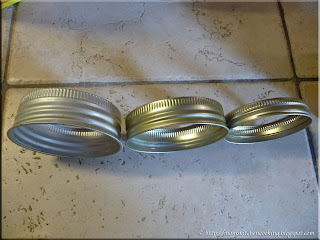
There are two options for closures for Gem jars.  There are the original glass inserts with metal bands and rubber gaskets as pictured.  The rubber gaskets, made by Viceroy (Weston, Ontario) are still in production and available on a limited basis depending on location.  I paid $1.99 for a box of 12 at Home Hardware.  I did notice that while these gaskets were originally made in Canada the newer boxes say 'made in Sri Lanka' and they are now about triple the price I used to pay for them .  The rubber gaskets fit on the glass insert.  A deeper metal band is necessary to use the glass inserts.  Note that these are not zinc bands (see previous post).  They assembled glass insert and rubber gasket is placed on the filled jar then the band is tightened and turned back a quarter inch for processing.  Immediately after removing from the canner the band is fully tightened and left for the cooling period.  The band is then removed.  If the jar did not seal, it will be immediately apparent as the lid will pop right off with no pressure.  While the glass inserts are not recommended by the USDA they are a viable, eco-friendly alternative to the metal snap lids AND there is no worry over BPA leaching into your food.  The second option is the metal snap lids.  A box of bands and lids cost about $8.50 for 12; lids without the bands can be bought in a box of a dozen as well.  Both are available at Home Hardware. 
Gem jar band comparison
Of note are the bands for the Gem jars.  The silver coloured widest band (left) is for use on the jars when using a glass insert and rubber gasket.  The centre gold band is for use on the jars when using a metal snap lid.  The smaller, narrowest band (right) is a standard mouth (70 mm) band to show the difference in band depth between Gem jars and the standard or wide mouth bands both of which are not as deep as the Gem band.

Gem jars are mainly used in Canada specifically the prairie provinces and the jars themselves are no longer in production, only the metal snap lids for the jars.  Canning jars tend to get around because home canned foods are gifted so it is quite possible to find Gem jars throughout North America.  Generally what has happened is these jars get discarded because there were no available lids.  To date there are no Tattler or 4ever recap lids available for the Gem jars although I did see where Tattler may consider it.  While Bernardin does make plastic storage lids in both standard and wide mouth sizes, they do not make them for Gem.  There is also no Gem size attachment for food savers to vacuum seal the jars however, Gem jars can be vacuum sealed using the canister method.

I am beyond excited at acquiring this number of Gem jars!  They effectively replace two dozen of my regular jars AND complete with the glass inserts are one step further from depending on the metal snap lids.   Not only that, I also have the option of using the Gem metal snap lids even though they are a little over double the price of wide mouth that are more expensive than stand lids.  Still, having the option is nice!  Now it's time to get all these jars filled with this years harvest...


Sunday, July 03, 2011

Norpac All Beef Franks

Canada Day for many signifies the official start of summer.  The traditional fare for this holiday is barbeque, usually hot dogs and hamburgers.  Both are perfect crowd pleasers and larger family get togethers.  We don't eat hot dogs very often but when we do, they must be all beef.    We discovered Norpac's all beef franks so decided to try them.

norpac all beef franks
Norpac is a Canadian beef processing plant located in Norwich, Ontario.  It is owned by the Heleniak family.  Twenty percent of all the beef fed under their program are raised by the family.  Their philosophy on raising and processing cattle is quite impressive.  The cattle in their program is locally raised under their strict guidelines.  All cattle grown under the Norpac program must be less than 24 months old and BSE free.  The cattle are fed a 100% vegetarian diet that is hormone and antibiotic free, free choice system.

Norpac's all beef franks made from Ontario corn fed beef.  The ingredients are:  beef, water, soya flour, salt, spices, sodium phosphate, sodium erythobate, sodium nitrate, and smoke.  Sodium erythrobate is the salt of erythorbic acid, a variation of ascorbic acid (Vitamin C).  It is extracted from the sugars in sugar beets, sugar cane and corn.  It replaces sulfites as a response to increased consumer sulfite allergies by food manufacturers as a preservative and to retain the colour in cured meats.  Of note though is this ingredient should be avoided if you have a corn allergy, something that is also increasing.

hot made with norpac all beef franks
We sliced open the franks lengthwise then pan fried them.  They were topped with cheddar cheese that was allowed to melt before placin on toasted sesame seed hot dog buns.  Additional toppings included mustard, ketchup and caramelized onions.

These delicious, mouth watering franks are considerably more expensive than other brands of weiners and about double the price of all beef wieners.  A package of six costs $5.99 or $1 per frank.  They are a bit larger than regular wieners though.  These franks are well worth the extra cost!  I'm looking forward to trying them on the grill. 


Sunday, May 08, 2011

Canadian Made - Harvey's

Harvey's burger

There are very, very few fast food burgers that I like.  Most are too high in fat, carbs and salt but sadly lacking in flavour.  How the fast food restaurants could manage to ruin something as simple as a good hamburger is beyond me.  Well, thinking about it the all mighty dollar does have a factor in the equation with the fast food restaurants constantly trying to cut costs to meet the ever rising demands of consumers for cheaper priced burgers.

Years ago while still dating, one of our favourite burger joints was Harvey's.  It continues to be one of our favourites for fast food restaurants.  Harvey's a Canadian owned and operated fast food restaurant chain with locations concentrated in southern Ontario, southern Quebec, the Maritimes, Manitoba, British Columbia, and Alberta.  Harvey's was founded in Richmon Hill, Ontario in early 1959 by George B. Sukornyk and Rick Mauran .  The first Harvey's opened on April 1, 1959.  Headquarters are located in Vaughan, Ontario.  It is the second-largest Canadian-established restaurant chain next to Tim Hortons, and is the fourth-largest burger chain in Canada.  The restaurant's popularity stems from having your burger your way.  The burger patties are char-gilled, placed on the wrapping paper then transferred to the loading station that is a choose your own topping counter with an employee ready to top your burger with your choices from a selection of eleven items.  It's quite similar to a Subway set-up with the employee on one side of the counter, customer on the other and delectable toppings in between. 


Sunday, May 01, 2011

Canadian Made - Red River Cereal

Red River Cereal

I can remember many a morning starting the day with a steaming bowl of Red River Cereal.  This unique Canadian cereal is made from cracked wheat, cracked rye, whole and cracked flax.  It is 100% natural with not additives making it one of our hot cereals of choice even now.    I prefer it over oatmeal or cream of wheat Red River Cereal is named after the Red River Valley in Manitoba.  This wonderful Canadian cereal is not available outside of Canada although thanks to the wonders of the internet and global shopping that is changing.

The Red River Cereal company was established in Manitoba in 1924.  In 2004 is was bought by International Multifoods Corporation.  The Red River brand name is currently owned by Robin Hood Multifoods, Inc. of Markham, Ontario, a division of Smucker Foods of Canada Co.  The cereal continues to be 100% all natural.  Of interest if you notice on the box the COR 66 in a circle.  The COR number is somewhat like a factory number, a way of identifying where that product came from. 

In Canada, growers have various contracts.  For example, here some growers grow tomatoes for Heinz while others grow for Alymer.  In any given county there will be a division of the growers and who they are growing for.  A COR number is assigned  to the growers in a particular area by some companies.  Which means they can later identify the location where the produce was grown if there is ever a problem.  In this case the grains in the cereal came from the COR growers group 66.


Sunday, April 24, 2011

Canadian Made - The Small Time Farmer

Goodness I guess I need to get busy making a badge or banner for my new series, Canadian Made.  Today's Canadian Made focuses on the small time Canadian farmer.  I grew up in Canadian farmland, surrounded by Canadian farmers and still live surrounded by the same.  I wouldn't have it any other way!  Here in beautiful Ontario, Canada I only have to walk about 500 yards to reach the first farmer's field.  This is small time farming at it's prime.  Many of the farmers here own 1,000 acres or less.  Livestock usually consists of what the farmers use themselves perhaps with a few extra chickens to sell the eggs.  It is their livelihood and despite all the jokes about rich farmers, most aren't.  In fact many of these small time farmers are forced to work off the land just to be able to make ends meet and it is very common for their wives to work off the land.

Winter months are quiet with little to do on the farm besides plan for the up coming growing season, work on the house and out buildings and catch-up.  Usually by now the farmers have taken to the fields, plowing then planting.  It is quite common to look out across the field to see the lights of a tractor working away close to midnight this time of year.  Next comes the fertilizing and irrigation if needed followed by the very, very busy harvest season during which time the farmer can be seen working well into the wee hours of the morning to get the crop off or meet their quota.

The life of a small time farmer is not easy.  True they get to work from home but the expenses are high and the pay is low.  They are technically self-employed meaning no government pension plan, no medical benefits, no dental benefits, no presciption coverage, and no calling in sick just because they need a me day.  The weather dictates how successful their crop will be and getting that quota is the goal because if they don't they likely won't get a contract the following year.  Despite all of the adversity, small time Canadian farmers continue their way of life to bring food to the Canadian table.  And a Canadian tradition continues...